This amazing tool is available by subscription. There is a one time fee of $1997 then $39.99 per month. However, I am able to offer you this amazing tool at the great discount of $19.99 per month with no one time fee, and you will also get the first month free to try it out. I'm not sure how long this great offer will last so be sure to register TODAY. Click here to get this great offer.
Showing posts with label Tools Of The Trade. Show all posts
Showing posts with label Tools Of The Trade. Show all posts
Monday, February 09, 2015
The Perfect Real Estate Investors Tool
As a real estate investor we all know that our network is our net worth. For any real estate transaction the is a buyer, a seller, and a lander. The Real Estate Connect Center helps you make those very connections.
This amazing tool is available by subscription. There is a one time fee of $1997 then $39.99 per month. However, I am able to offer you this amazing tool at the great discount of $19.99 per month with no one time fee, and you will also get the first month free to try it out. I'm not sure how long this great offer will last so be sure to register TODAY. Click here to get this great offer.
This amazing tool is available by subscription. There is a one time fee of $1997 then $39.99 per month. However, I am able to offer you this amazing tool at the great discount of $19.99 per month with no one time fee, and you will also get the first month free to try it out. I'm not sure how long this great offer will last so be sure to register TODAY. Click here to get this great offer.

Wednesday, January 28, 2015
Smart Phone In My Business
I have to chance to interact with a lot of other investors with my work with Rich Dad Education, with my work with the Investor Cashflow Club, and with my day to day networking for my own real estate investment business. We discussed investment strategies, on going deals, and how we run our businesses. Time and time again I am asked how I manage my business on road and how I purchase properties from afar. It's simple, I have a Smart Phone, and I use it to it's capacity.
So today I've put together a presentation on how I use my smart phone in my real estate business; and the different apps that make running my business easier.
These are the apps I've come across and started using to better my business. I find new one all the time. If you use an app that is helping you run your business, please take a moment to comment about it on this blog.
So today I've put together a presentation on how I use my smart phone in my real estate business; and the different apps that make running my business easier.
These are the apps I've come across and started using to better my business. I find new one all the time. If you use an app that is helping you run your business, please take a moment to comment about it on this blog.
Sunday, September 14, 2014
Q&A Network Event
My oh my what fun we had last night!!!
I love attending and hosting network event. Real estate talks are a plenty and the topic is so fascinating. Believe it or not, most people around me don't want to talk real estate and investment. I know, shocking right!
Well last night I was surrounded be willing chatters. More then that, we arrange for a Q&A during the event. Everyone who attended were given the chance to write down real estate investing questions and we answered and discussed each one. What an amazing learning opportunity that was. Also each questions entered them for a door prize. Congrats to Sarah who was our winner last night.

That's right, we wrote our questions on "$1000 dollar bills".
Here are some of the questions we discussed last night.
Q: Is Kijiji really a good tool for real estate investor? How would you use it?
A: Yes! Kijiji is a great tool, if you are a real estate investor you should use it. The most important aspect of a real estate investor's business in the connection we make with others. Real estate is a team sport. You will need renters, sellers, and buyers. Kijiji is a great way of finding them. Place an add, "Handyman Special" to look for flip buyers. "Stop Renting" to locate tenant-buyers.
Q: Should I renew my existing Kijiji add or create a new one?
A: Create a new one. Let there be a few adds for a few different offers. In fact you should have an ongoing presence on Kijiji. I try to place adds weekly. Let them scroll through and find a few from you. It will make you look like an active investor, not a tire kicker.
Q: Which are the best group of people to sell your properties to? Investors or non-investors?
A: Well if you have a multi-unit you will need to approach investors. These will not appeal to first time home-buyers. But if you are working on wholesale or rehabs, basically for a single family house. You can easily sell these to either an investor or a non-investor. However, educated investors knows that having a property under contract is still not a completed deal. Due diligence will indicate if it will be a go or not for example. However, when a homeowner puts pen to paper for a purchase contract; that is a done deal in their mind and will most likely close on the property.
Q: What exit strategy do you use?
A: Your first level of exit is the exit clause in your purchase contract. These are a must. Never EVER sign a purchase contract without exit clauses. EVER!!
Wholesale is the universal exit strategy. No matter with property or which strategy you are concentrating on, always be ready to wholesale. When in doubt, wholesale it out!
For a rent-to-own, if the tenant-buyer can not close at the end of the term, there are a few exit option. Extend the term if they are still a good candidate. If they leave the deal, then you can find a new tenant-buyer, sell, wholesale, or rent.
For a flip (rehab) you could always turn it into a rent-to-own, wholesale, or offer a VTB (Vendor Take Back) in hopes to attract more buyers.
Q: What is your favourite tool that you have used for real estate investing?
A: With this questions we took turns describing out favourite tools so here are a few ones that was discussed. DocuSign. I have talked about that app in a previous post. In fact you can view it here. DocuSign give you the ability to sign PDF files directly on your phone or tablet and email the signed copy. So when I am on the road, if I have a realtor send me a purchase contract I can sign and send it back from my phone and not delaying giving the chance for other investors to put in offers in before me.
Team Viewer. This program give you the ability to access the desktop on your computer at home from anywhere. This gives you easy access to all your files and programs no matter where you may be. "Let me call you back when I get back to my office" will no longer be a viable excuse. OneDrive is a similar program available. Of course there are so hacking concerns, be aware.
You can do business from anywhere. You can fill your day with which ever activity you which and maintain your business as needs arise from wherever.
Q: What should I know about purchasing a house for a bank for a wholesale deal?
A: Don't. The wholesale strategy is purchasing a property with equity. By law, in Canada, a foreclosed property must be listed and sold by a realtor at or as close to fair market value as possible. So basically that means there will be no equity in this deal. Not only that, foreclosure have a reputation to be a great deal (even if they are not). Therefore many buyers look for foreclosed property and then they offer top dollars to secure the properties causing for these properties to sell for sometime more then fair market price. So to recap, you could find a good deal in a foreclosure, but the fact that it is a foreclosure does not guarantee for it to be a deal.
Q: How do you get a money partner to pull the trigger on a deal?
A: This question triggered a great group discussion and a few key points where brought up. It is harder to deal with new investors. If this is going to be their first "deal" that they will be involved with, they will be more nervous and they will be easily get cold feet. The best strategy to use here, in my opinion, is to keep the process of investing with you simple. Keep them out of the minutia as much as possible. Also do not drag on the process. Here is an example: "To invest with me, it is a simple three step process. One - qualify you with a mortgage broker. Two - information review (in a nicely compiled rapport, all at one time not bombarding them with tiny details every few days.) Three - Sign contract. Get a signed commitment of some sort before removing condition on the deal. Ideally get the money prior to that (in trust with the real estate lawyer). But having them put pen to paper, even if it's just on a letter of intent requires a level of commitment. If they hesitate at that stage, they will not likely close.
Our door prize was also the ideal answer for this issue. Pitch Anything is about how to present and close on deals. I have posted on the topic of that book in the past. You can view it here.

There will be more network events and there will be more Q&A. If you would like to submit questions even if you can not attend, email your questions to me here and get in the learning. Every questions submitted will be entered in a draw for a digital gift.

I love attending and hosting network event. Real estate talks are a plenty and the topic is so fascinating. Believe it or not, most people around me don't want to talk real estate and investment. I know, shocking right!
Well last night I was surrounded be willing chatters. More then that, we arrange for a Q&A during the event. Everyone who attended were given the chance to write down real estate investing questions and we answered and discussed each one. What an amazing learning opportunity that was. Also each questions entered them for a door prize. Congrats to Sarah who was our winner last night.
That's right, we wrote our questions on "$1000 dollar bills".
Here are some of the questions we discussed last night.
Q: Is Kijiji really a good tool for real estate investor? How would you use it?
A: Yes! Kijiji is a great tool, if you are a real estate investor you should use it. The most important aspect of a real estate investor's business in the connection we make with others. Real estate is a team sport. You will need renters, sellers, and buyers. Kijiji is a great way of finding them. Place an add, "Handyman Special" to look for flip buyers. "Stop Renting" to locate tenant-buyers.
Q: Should I renew my existing Kijiji add or create a new one?
A: Create a new one. Let there be a few adds for a few different offers. In fact you should have an ongoing presence on Kijiji. I try to place adds weekly. Let them scroll through and find a few from you. It will make you look like an active investor, not a tire kicker.
Q: Which are the best group of people to sell your properties to? Investors or non-investors?
A: Well if you have a multi-unit you will need to approach investors. These will not appeal to first time home-buyers. But if you are working on wholesale or rehabs, basically for a single family house. You can easily sell these to either an investor or a non-investor. However, educated investors knows that having a property under contract is still not a completed deal. Due diligence will indicate if it will be a go or not for example. However, when a homeowner puts pen to paper for a purchase contract; that is a done deal in their mind and will most likely close on the property.
Q: What exit strategy do you use?
A: Your first level of exit is the exit clause in your purchase contract. These are a must. Never EVER sign a purchase contract without exit clauses. EVER!!
Wholesale is the universal exit strategy. No matter with property or which strategy you are concentrating on, always be ready to wholesale. When in doubt, wholesale it out!
For a rent-to-own, if the tenant-buyer can not close at the end of the term, there are a few exit option. Extend the term if they are still a good candidate. If they leave the deal, then you can find a new tenant-buyer, sell, wholesale, or rent.
For a flip (rehab) you could always turn it into a rent-to-own, wholesale, or offer a VTB (Vendor Take Back) in hopes to attract more buyers.
Q: What is your favourite tool that you have used for real estate investing?
A: With this questions we took turns describing out favourite tools so here are a few ones that was discussed. DocuSign. I have talked about that app in a previous post. In fact you can view it here. DocuSign give you the ability to sign PDF files directly on your phone or tablet and email the signed copy. So when I am on the road, if I have a realtor send me a purchase contract I can sign and send it back from my phone and not delaying giving the chance for other investors to put in offers in before me.
Team Viewer. This program give you the ability to access the desktop on your computer at home from anywhere. This gives you easy access to all your files and programs no matter where you may be. "Let me call you back when I get back to my office" will no longer be a viable excuse. OneDrive is a similar program available. Of course there are so hacking concerns, be aware.
You can do business from anywhere. You can fill your day with which ever activity you which and maintain your business as needs arise from wherever.
Q: What should I know about purchasing a house for a bank for a wholesale deal?
A: Don't. The wholesale strategy is purchasing a property with equity. By law, in Canada, a foreclosed property must be listed and sold by a realtor at or as close to fair market value as possible. So basically that means there will be no equity in this deal. Not only that, foreclosure have a reputation to be a great deal (even if they are not). Therefore many buyers look for foreclosed property and then they offer top dollars to secure the properties causing for these properties to sell for sometime more then fair market price. So to recap, you could find a good deal in a foreclosure, but the fact that it is a foreclosure does not guarantee for it to be a deal.
Q: How do you get a money partner to pull the trigger on a deal?
A: This question triggered a great group discussion and a few key points where brought up. It is harder to deal with new investors. If this is going to be their first "deal" that they will be involved with, they will be more nervous and they will be easily get cold feet. The best strategy to use here, in my opinion, is to keep the process of investing with you simple. Keep them out of the minutia as much as possible. Also do not drag on the process. Here is an example: "To invest with me, it is a simple three step process. One - qualify you with a mortgage broker. Two - information review (in a nicely compiled rapport, all at one time not bombarding them with tiny details every few days.) Three - Sign contract. Get a signed commitment of some sort before removing condition on the deal. Ideally get the money prior to that (in trust with the real estate lawyer). But having them put pen to paper, even if it's just on a letter of intent requires a level of commitment. If they hesitate at that stage, they will not likely close.
Our door prize was also the ideal answer for this issue. Pitch Anything is about how to present and close on deals. I have posted on the topic of that book in the past. You can view it here.
There will be more network events and there will be more Q&A. If you would like to submit questions even if you can not attend, email your questions to me here and get in the learning. Every questions submitted will be entered in a draw for a digital gift.
Sunday, April 06, 2014
Why Helping With Financing Is A Benefit For The Seller
Have you ever had a property for sale, but there were no buyers? Or you had a buyer with a desirable offer in place but the financing fell through? Or your real estate agent as been recommending you lower your price again and again, so that after paying your realtors fees you are left with very little from the equity of your property?
It can be very disappointing to have been working so hard paying down the mortgage on your property to build up the equity just to see it disappear in the details of the sale. There are different ways to maximize the amount that goes in your pocket from the sale of your house. Today I will be concentrating on assisting with the financing.

For a first time home buyer, they should be able to purchase a property with a deposit of 5%. So for a $300,000 home that would be $15,000. That's not so bad. It gets a little harder to obtain when you think that a big majority of first time buyers first attended college or university. They might have been concentrating on paying down student loans instead of saving for a down payment.
Not only that, but banks and CMHC have been changing their rules surrounding mortgages, making obtaining a mortgage a little harder and sometimes needing a larger down payment. In fact, CMHC as just increased their rate to insure a home mortgage by about 15%. It might be easier to obtain a mortgage without going through the regulation of a CMHC mortgage. But in order to do so the down payment would now need to be 20%. For that $300,000 house that is now $60,000. On top of paying off student loans.
For commercial mortgages, the necessary down payment is 35%. On a $300,000 purchase price that would be $105,000. Down payments are so high in commercial mortgage that assisting in financing is very common. The most common form of assisting is with a VTB (Vendor Take Back mortgage). There would still be a regular first position mortgage with the traditional lender (Bank). Then the seller would hold a second position mortgage against the equity of the property.
On that $300,000 example, lets assume the bank is holding 65% on a first position mortgage ($195,000) and that the seller is agreeing to holding a VTB for 20% of the property value ($60,000) this would leave the buyer with the responsibility of supplying a down payment of 15% ($45,000). This would make the whole transaction much more feasible for the buyer since he now as to come up with only $45,000 for the down payment instead of $105,000.
Now, lets discuss what is in it for the seller. First, he is getting the property sold when the large deposit of this deal might have scared potential buyers away. However he is not getting the full asking price up front. In fact in this example he would receive $240,000 at closing. But he did not have to lower the price. The remaining $60,000 is still due to him in the form of a mortgage. And not only that but it is secured against the property he just sold. The terms of the mortgage was determined between the buyer and the seller during the negotiation of the sell.
I have in the past, posted about the types of rates you can expect for holding a second position mortgage. You can review that here. Based on that information, lets assume the seller and buyer in our example agreed to an interest rate of 10% and for a term of 5 years. For simplicity sake lets also assume that they agreed to make the payments interest only. (As a investor buyer, I prefer interest only as it gives me a smaller monthly payment therefore improving my monthly cashflow. As a seller, it gives me more money in the long run.) In this example the seller would be receiving a monthly payment of $500 ($60,000 x 10% which is then divided by 12 months). So after the 5 year term, the seller would have collected $30,000 in payments on top of being paid back for the $60,000 VTB. By offering a VTB, in this example, not only was the seller able to facilitate the sale and get his asking price; he also collected an additional $30,000.
Sometimes, there is not enough available equity to offer a traditional VTB, mostly if there are realtor fees involve. This is where Arm's Length Mortgages could be used instead.
Within your registered account, such as an RRSP; you can hold stock and mutual funds. But did you know you could also hold a mortgage? These are called Arm's Length Mortgages. They can only be used on property you, or a close relative do not own. Hence the term Arm's Length Mortgage. Just like the VTB the terms of the Arm's Length Mortgage would be negotiated between the buyer and RRSP owner. As an RRSP owner you could offer to hold an Arm's Length Mortgage on any properties (not mobile homes) that the buyer is purchasing or is owning. But you could also offer that service on the property you are selling if there was no equity for a VTB of if you are in need of that equity right away.
Here is how this would take place. You sell you property for $300,000. The bank is providing a 1st position mortgage of $195,000. The buyer as a deposit of $45,000. You would have $60,000 of your RRSP moved to a self manage RRSP which would then be transferred to a Trustee (such as Olympia Trust) that would facilitate the mortgage. The trustee would then create the mortgage which is registered against the property and at closing a cheque would be issued and sent to you. At closing you would receive, $195,000 from the bank mortgage, $60,000 from the Arm's Length Mortgage as well as the $45,000 deposit from the buyer. For a total of $300,000. So even though you are helping with financing you will be collecting in cash the full asking price.
Going forward regular payments would be deposited in the trust account (back into your RRSP). At the end of the term, the seller would refinance the property and pay off the Arm's Length Mortgage which would return all the remaining principal and interest due back to your RRSP. Take note, the RRSP money was only ever transferred within the registered account and therefore never created a taxable event. Also the interest made on the mortgage was also within the RRSP and is as such under the same protection had it been made in the stock market. But I think we will all agree that the RRSP secured to the property is much more secure then an RRSP holding stocks or mutual funds at the mercy of a volatile market.
One of the disadvantage of holding an Arm's Length Mortgage is that the additional money made from holding the mortgage ($30,000) is held within the RRSP account and technically should only be used at your retirement. But seeing as this is extra money that you would not have made with a traditional sale; I think the trade off is fair.

Sometimes, there is not enough available equity to offer a traditional VTB, mostly if there are realtor fees involve. This is where Arm's Length Mortgages could be used instead.
Within your registered account, such as an RRSP; you can hold stock and mutual funds. But did you know you could also hold a mortgage? These are called Arm's Length Mortgages. They can only be used on property you, or a close relative do not own. Hence the term Arm's Length Mortgage. Just like the VTB the terms of the Arm's Length Mortgage would be negotiated between the buyer and RRSP owner. As an RRSP owner you could offer to hold an Arm's Length Mortgage on any properties (not mobile homes) that the buyer is purchasing or is owning. But you could also offer that service on the property you are selling if there was no equity for a VTB of if you are in need of that equity right away.
Here is how this would take place. You sell you property for $300,000. The bank is providing a 1st position mortgage of $195,000. The buyer as a deposit of $45,000. You would have $60,000 of your RRSP moved to a self manage RRSP which would then be transferred to a Trustee (such as Olympia Trust) that would facilitate the mortgage. The trustee would then create the mortgage which is registered against the property and at closing a cheque would be issued and sent to you. At closing you would receive, $195,000 from the bank mortgage, $60,000 from the Arm's Length Mortgage as well as the $45,000 deposit from the buyer. For a total of $300,000. So even though you are helping with financing you will be collecting in cash the full asking price.
Going forward regular payments would be deposited in the trust account (back into your RRSP). At the end of the term, the seller would refinance the property and pay off the Arm's Length Mortgage which would return all the remaining principal and interest due back to your RRSP. Take note, the RRSP money was only ever transferred within the registered account and therefore never created a taxable event. Also the interest made on the mortgage was also within the RRSP and is as such under the same protection had it been made in the stock market. But I think we will all agree that the RRSP secured to the property is much more secure then an RRSP holding stocks or mutual funds at the mercy of a volatile market.
One of the disadvantage of holding an Arm's Length Mortgage is that the additional money made from holding the mortgage ($30,000) is held within the RRSP account and technically should only be used at your retirement. But seeing as this is extra money that you would not have made with a traditional sale; I think the trade off is fair.
Tuesday, February 11, 2014
Life Or Fiction?
I've been playing the game Cashflow 101 a lot lately. If you are unaware, Cashflow 101 is a game that was created by Robert Kiyosaki to use as a tool for teaching the general public about investing. But can a game really teach how to invest in the real life?

Mr Kiyosaki's game as a few advantages. Firstly as described in the cone of learning, there are a few ways of learning, each with different success. The study shows that we retain less in passive forms of learning such as reading, listening to a lecture, to watching a demonstration as oppose to an active form of learning such as giving a talk, simulation to doing the real thing.

The best way to learn is by doing the real thing. But if we are uneducated, there can be serious risks in trying to learn to invest by trial and error. Which is the next best advantage of the game, it provides a safe environment to simulate deals in investing. That is the reason, Cashflow 101, is used as a training tool.
You start by randomly selecting a "life", you may be a Doctor to a Mechanic. Your income and expenses will vary depending on your job. Although a Doctor as a much higher income, he also as substantial student debts and lives in a more expensive house then the Mechanic. Very much like real life. We tend to live at the extreme of our means. When our income increases, so does our style of living.
From there we fill out a financial statement to match the "life" we picked. Even when they were deeply into debt, Robert and his wife Kim, always employed the use of an accountant to know what there exact financial situation was. When facing difficult financial times, most of us try to ignore the issues and hope things will work out. Robert and Kim chose to look at the problem head on in order to find a solution.

The game start in the inner circle called the rat race. As described by Wikepidia:

The goal of the game is to escape the rat race by becoming financially independence. To accomplish that, the player needs to accumulate enough passive income to cover their total expenses. Passive income will come in the form of the cashflow of rental properties and/or businesses.
When someone new starts to play cashflow for the first time, they automatically play the game the same way they live their lives. Non-investors concentrate on small deals and only use the cash they have on hand to secure investment. In that manner, they will probably be able to secure a few small investments but they would need to play for a very long time in order to secure enough for their financial independence. In comparison to real life, if following that tactics, the course of our professional life will have ended before accumulating the necessary cashflow. Although, any passive income is good and will offer some financial relief.

The more they play, new players will discover that in order to exit the rat race, they will need to acquirer more capital to purchase the deals or to get comfortable with debt. Very much like investing in real life. Robert Kiyosaki as made using debt very uncomfortable by making the interest rate at 10% a month. That's right, a month! That would be 120% a year. That portion of the game is a little unrealistic, but the purpose of this is to get the players to really confront their fear of debt. The biggest obstacle in being successful investors is our mindset, and fear and doubt will keep our mindset on the wrong side of the quadrant (see this past post to learn more about the different cashflow quadrant).
I have taken many different investment courses now, in both the financial market (stocks) and for real estate investing. Still, I try to play the Cashflow game weekly. You see, seeking financial freedom and embracing debt to reach that goal if very much against the normal way of thinking. I use the Cashflow game as a way to keep my mind sharp in figuring out creative solution to acquire investment deals, as well as keeping my mindset on the right track.
I strongly recommend you play the game as often as you can. Change the rules around a little to keep the play interesting and challenging. You may want to join a Cashflow Club. They can be found in almost every city around the world.

Mr Kiyosaki's game as a few advantages. Firstly as described in the cone of learning, there are a few ways of learning, each with different success. The study shows that we retain less in passive forms of learning such as reading, listening to a lecture, to watching a demonstration as oppose to an active form of learning such as giving a talk, simulation to doing the real thing.
The best way to learn is by doing the real thing. But if we are uneducated, there can be serious risks in trying to learn to invest by trial and error. Which is the next best advantage of the game, it provides a safe environment to simulate deals in investing. That is the reason, Cashflow 101, is used as a training tool.
You start by randomly selecting a "life", you may be a Doctor to a Mechanic. Your income and expenses will vary depending on your job. Although a Doctor as a much higher income, he also as substantial student debts and lives in a more expensive house then the Mechanic. Very much like real life. We tend to live at the extreme of our means. When our income increases, so does our style of living.
From there we fill out a financial statement to match the "life" we picked. Even when they were deeply into debt, Robert and his wife Kim, always employed the use of an accountant to know what there exact financial situation was. When facing difficult financial times, most of us try to ignore the issues and hope things will work out. Robert and Kim chose to look at the problem head on in order to find a solution.
The game start in the inner circle called the rat race. As described by Wikepidia:
A rat race is an endless, self-defeating, or pointless pursuit. It conjures up the image of the futile efforts of a lab rat trying to escape while running around a maze or in a wheel. In an analogy to the modern city, many rats in a single maze expend a lot of effort running around, but ultimately achieve nothing (meaningful) either collectively or individually. This is often used in reference to work.We work hard long hours for the goal of a paycheck. We then spend that paycheck to acquirer the things we need or want and then have to do it all over again to maintain that life style. That is an honorable way of living. The only problem is that if something happens and the employment is terminated for whatever the reason, it becomes impossible to maintain our life style. Many of us, following this life style, will never be fully prepared to retire, let alone retire comfortably.
The goal of the game is to escape the rat race by becoming financially independence. To accomplish that, the player needs to accumulate enough passive income to cover their total expenses. Passive income will come in the form of the cashflow of rental properties and/or businesses.
When someone new starts to play cashflow for the first time, they automatically play the game the same way they live their lives. Non-investors concentrate on small deals and only use the cash they have on hand to secure investment. In that manner, they will probably be able to secure a few small investments but they would need to play for a very long time in order to secure enough for their financial independence. In comparison to real life, if following that tactics, the course of our professional life will have ended before accumulating the necessary cashflow. Although, any passive income is good and will offer some financial relief.
The more they play, new players will discover that in order to exit the rat race, they will need to acquirer more capital to purchase the deals or to get comfortable with debt. Very much like investing in real life. Robert Kiyosaki as made using debt very uncomfortable by making the interest rate at 10% a month. That's right, a month! That would be 120% a year. That portion of the game is a little unrealistic, but the purpose of this is to get the players to really confront their fear of debt. The biggest obstacle in being successful investors is our mindset, and fear and doubt will keep our mindset on the wrong side of the quadrant (see this past post to learn more about the different cashflow quadrant).
I have taken many different investment courses now, in both the financial market (stocks) and for real estate investing. Still, I try to play the Cashflow game weekly. You see, seeking financial freedom and embracing debt to reach that goal if very much against the normal way of thinking. I use the Cashflow game as a way to keep my mind sharp in figuring out creative solution to acquire investment deals, as well as keeping my mindset on the right track.
I strongly recommend you play the game as often as you can. Change the rules around a little to keep the play interesting and challenging. You may want to join a Cashflow Club. They can be found in almost every city around the world.
Saturday, February 01, 2014
Networking Etiquette
I have been debating topic for this blog all week. Selecting and dismissing different ideas a few times a day. Until I talked to a fellow real estate investor who is currently attending an advance real estate class. A big part and advantage of taking the class is to network with all the other investors attending. The instructor actually strongly suggest that all attendees network with each other.
I asked how the networking was going, I was interested to know what that particular group concentrated on style of investment and how active they were with investing. Our conversation diverted to networking strategies and she pointed out one encounter in particular that turned her off future prospect to deal with a particular investor.
EUREKA!!!
There! This is what I should post about in my blog (which is always a topic that I could personally have brushed up).

I asked how the networking was going, I was interested to know what that particular group concentrated on style of investment and how active they were with investing. Our conversation diverted to networking strategies and she pointed out one encounter in particular that turned her off future prospect to deal with a particular investor.
EUREKA!!!
There! This is what I should post about in my blog (which is always a topic that I could personally have brushed up).
Picture from FreeDigitalPhotos.net
Why Network?
Why should we concentrate on networking at all. In fact, I'm a mother of young children, living in a fairly remote area. In order to attend Networking Event, it requires traveling, planning and often a babysitter. It would be so much easier to simply stay home. If I was only investing in the stock market, networking would be almost useless. But Real Estate Investing, is a team sport. You cannot invest in real estate on your own. In fact even the simplest of deals include a buyer, a seller, a lawyer, a lender (institutional or private) and most time a realtor.
So in order to facilitate current or future deals, it would be helpful to have an existing form of relationship with buyers, sellers, lawyers, lenders and realtors.
When Am I Networking?
Whenever you are interacting with someone who could hold the position of buyer, seller, lawyer, lender and realtor, you are networking. Every time some one asked you "What have you been up to?", or "What do you do?", include in your answer something about your real estate business. Don't overwhelm everyone you meet with offers or request for money so that you develop a reputation and that people in your surrounding starts trying to avoid you. But if they show interest, by all means, elaborate more. Most of those encounters may not result in a deal but you never know who may end up having a role in your real estate business.
There are also, more organized event with the intention to network with a specific group of people. Such as a Investor Cashflow Club event, or a Canada REIC event, etc. The benefit of these event is that the other attendees are also there to seek out a role in a current or future investment opportunity. The likeliness of finding someone that could benefit your real estate business is now much more likely. You may have to try out a different events/groups to see which one will offer the best value. Does the event include an educational portion? Is that educational portion supporting your business? Let me elaborate on this. I once attended an event that was organized by an investor group that included a presentation. The group's vision was very limited, mostly when compared to my goals. They only entertained renting single family home, evaluated their deals based on the appreciation over cashflow, they turned their nose to more creative arrangement and as investors didn't seek out any protection or tax benefit a corporation could offer. So their loyal attendees where "brain washed" against my particular kind of investment. They could prove useful if I wanted to get rid of a deal I deemed unfit for myself however. Also be careful for tire kickers. Some group may include investor fans more then investors. They are on the sideline and have yet to have the opportunity or the courage to jump on board. Again, some of those people may become first time investor with you, but there is also a high likelihood that they wont.
It's important to understand that I am not suggesting you do not attend such events, but if you do, take your time and money commitment vs. result into account. You may still find it advantageous to you.
Networking Dos and Don'ts!
Don't Be Shy:
You may be shy. And that is completely okay, in fact I do not suggest that you change yourself at all. That being said, if in a crowd, you prefer to stay seated away from the crowd and to keep your eyes on the floor/phone/papers; you might as well have stayed home. You will have end up accomplishing just as much in the way of network. Some people have the self confidence to walk into a crowd wearing an outrageous outfit intended to draw attention. Some can have an outburst declaring they have a deal looking for a buyer/seller/investor. That may not be you; it is not me and it's definitely not my husband. But you need to be able to approach individuals to introduce yourself and spark up a conversation. If you know that you can not accomplish that, then seek out the people in the crowd that you know and join their ongoing conversation or attend an event with someone more outgoing that will be the ice breaker for you.
Have Business Cards, Many Of Them:
You should always have business cards with you, but if you are attending an event with the intention to network bring many business card. Do not use the excuse of not having a business card design. I have sometime people not produce a business card and say I'm still working on my logo. Please! I don't want to invest with your logo, I'm considering to invest with you. If you can not produce a business card to me, I automatically associate you to as a amateur. That may be what you are, and that is fine, but that is NOT what you want me to think about you. Have a business card. Even if all it as on it is your name, phone number and email address. In fact that is all I have on mine. I also do not accept the excuse "They have not arrive yet". If you know you have a network event coming up, order some cards the minute you start thinking about attending. If it was a last minute thing, print some from home. They may not have the same professional look but it's better then nothing. If you think you can't afford them, Google free business cards. Vista print as been know to offer that.
Business Cards Turn Off:
We have being advised to have bright and flashy bird dog cards. A bird dog card should not be your business card. Although you should do something to have an appealing and memorable business card, I don't recommend making it neon coloured. Make sure your card is easy to read. Do not make the font too small, blurry or hard to read against the background. Unconsciously, if reading your business card is "hard maintenance", that is the sentiment I would associate to you. The same if it was rude, unprofessional, or boring.
Be careful of the information provided on your card. If you are in the construction business and are also looking to network for growing your client database for that business, please go ahead and hand out that card. If you give me a dog grooming business card, expect a call about my dog, not my real estate deals. If you need to have more then one kind of business card, so be it. Do not have a multipurpose card with both dog grooming and real estate investing on it.
Email accounts are free. There is no reason why I should receive a business card with an email that includes any of these words: cutie, sexy, hottie, biker. I even once saw one that included huggies, like the diapers.
There are some techniques on handing out a card that will draw more attention, as well as ways of designing a card. I won't get into this much details about those in this particular post. I'll save it for a later date.
Don't Drop/Grab And Go:
In a large setting, during an event with a lot of attendee, I will often come across people running around from person to person saying "Here is my card", "Here is my card", "Here is my card". That doesn't give the time to establish a positive first impression. It is true that to get the most of such a large event you may not want to dedicate an hour per person, but take the time to have a conversation, get a sense of what kind of investor they are. If there is an interest for future deals together, arrange to reconnect to talk or meet again at a later time.
Smile:
Smile! Be approachable, courteous and friendly. I would probably not approach someone who seems to be frowning at me. I would have no interest in dealing with someone who could not be friendly with me, but not only that if they are being rude to others. Also be positive. I have had friends that as soon as we get together they start numerating all the negative things going on in their lives. Or they will point out all the negatives in any situations or people they come across. Those friends would leave me feeling drained and ruined my good mood. As a result, I started avoiding them. If, on the other hand, I come across someone that is positive and uplifting, I tend to seek them out.
Include Those Around You:
When you are in a conversation with someone and someone approaches, re position yourself to include them. Don't keep your back to them but I don't think you should end your conversation mid sentence. When there is a break in the conversation, introduce yourself if you don't know them, if you do know them introduce them to the person you were conversing with. You shouldn't use a large network event to discuss details and try to close a deal in a private conversation. Reschedule a better time to have a meeting.
Have A Story:
If someone approach you in a network situation and ask what you do, do not reply "I'm a real estate investor". Your answer should give an sense of what you try to accomplish. You could say "I've been concentrating on Buy-Rent-Hold and starting to include Rent-To-Own" Or "I've invested in Ontario and looking to expend into Alberta". Someone once handed out a card and answered "Go see my website". For once the delay in explanation and the promise of a presentation screams Multi Level Marketing, not investor. Also, your story and personality needs to give me an incentive to visit that website.
Follow Up:
After the event, follow up with the people you have networked with. Depending on the conversation that took place have the appropriate follow up. Everyone should get an e-mail expressing your pleasure of making their acquaintances or for seeing them again. If they use and investment strategy that matches your expertise; ask for permission to send them details on current or future deals. If you had discussed getting together in a near future you could follow up with a phone call. But when someone who took my card in passing, calls me asking me bunch of questions on my business I can feel a little violated. It can be done, but do be tactful.
Also do not wait so long after the event that when you do touch base again they have completely forgotten you. Always help them remember you by telling them where you met "Hi Jon, Melanie here. We met last week at the Investor Cashflow supper..."
How do you keep track of that yourself? Well you don't have Pip's amazing memory, keep a database with those details in your network database.
Do Not Turn Other Events Into Your Personal Network Session:
Don't attend any event handing out cards right, left and center. Attend for it's true purpose. As an example, if I host a Tupperware party, don't show up with posters and pamphlet for your own business. But if a conversation with an other of my guest develops into asking more, by all means present your card and offer to discuss further at a later date. Show me some respect. The same goes for bigger events hosted by a group or a business.Appearance:
By appearance, I don't mean you have to go out and buy a three piece suit. But do dress professionally, business casual is fine as well. If I showed up in my coverall from my farm life, I am not going to inspire others to view me as a serious investor.
Conclusion
Real estate investing is about relationship. The purpose of networking should be to form and nurture those relationship. Be sure you have something to offer the people you network with as well as making sure they have something to offer you in return. The relationship you create may not be limited to only real estate. Take an interest in the people you meet, form friendships.
Tuesday, September 17, 2013
Tools Of The Trade: 3 Tiers
I was working at the Asset Protection class with Rich Dad Education covering the benefit of setting up a three tier corporation for your real estate investment. At the same time as I received an email from a real estate investor that offers real estate information emails and webinars. This particular email covered why a three tier corporation is not of much benefit for real estate investors.
Hmmm. What a coincidence.
In the email's defence, it is true that the set up of a three tier and following legal and accounting cost are significant. If your goal for your real estate business are small, they cost associated with a three tier may not be worth while. If however you are not limiting your potential with your real estate business and you are dedicated, the benefit of the benefit of the three tier could out weight the cost.
Many people are either advised by professional and decide on their own to start their business in their own name and later switch to a three tier. It may seem like sound advice but the problem with that is that you would have to deal with the capital gain at that time making it less worth while.
Before I explain a little bit about the three tier corporation let me make sure that it is clear I am neither a lawyer or an accountant and that before you set up this type of structure for your own real estate business you should seek the expertise of professional that have dealt with such structures.

Above is an example of the three tier structure. You are the shareholder of Holding Inc who in turn is the shareholder of Managing Inc and Real Estate Inc. Real Estate Inc as a contract with Managing Inc for managing all of it's properties. The benefit of doing this is that instead of the income being taxed as an investment income (40-45%) with Real Estate Inc, it would be taxed as an active income (15%) with the Managing Inc.
See the benefit? Also I am not touching base with the added benefit should you be sued, which as I've been told be a fellow investor is a matter of when not of if in the rental world.
I suggest you get more education on the matter of the three tier structure and to make a decision that will best suit your personal situation.
Hmmm. What a coincidence.
In the email's defence, it is true that the set up of a three tier and following legal and accounting cost are significant. If your goal for your real estate business are small, they cost associated with a three tier may not be worth while. If however you are not limiting your potential with your real estate business and you are dedicated, the benefit of the benefit of the three tier could out weight the cost.
Many people are either advised by professional and decide on their own to start their business in their own name and later switch to a three tier. It may seem like sound advice but the problem with that is that you would have to deal with the capital gain at that time making it less worth while.
Before I explain a little bit about the three tier corporation let me make sure that it is clear I am neither a lawyer or an accountant and that before you set up this type of structure for your own real estate business you should seek the expertise of professional that have dealt with such structures.
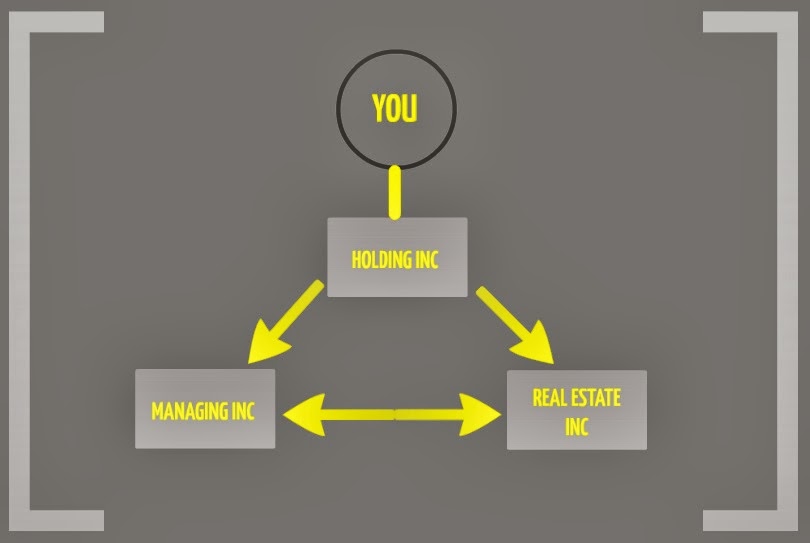
Above is an example of the three tier structure. You are the shareholder of Holding Inc who in turn is the shareholder of Managing Inc and Real Estate Inc. Real Estate Inc as a contract with Managing Inc for managing all of it's properties. The benefit of doing this is that instead of the income being taxed as an investment income (40-45%) with Real Estate Inc, it would be taxed as an active income (15%) with the Managing Inc.
See the benefit? Also I am not touching base with the added benefit should you be sued, which as I've been told be a fellow investor is a matter of when not of if in the rental world.
I suggest you get more education on the matter of the three tier structure and to make a decision that will best suit your personal situation.
Tuesday, September 10, 2013
Tools Of The Trade: Prezi
My friend, Chris, was my guest speaker this week for the "Q&A With Real Estate Investor" series. For his presentation he used a program called Prezi. I was very impressed. Our thought pattern is not linear, it grows on top of one and other more like branches of a tree. Prezi was a great way to liven up a presentation.
Tuesday, September 03, 2013
Tools Of The Trade: Empower Network
I am just back from working a Rich Dad Event in Ontario and after that a week of camping. We wanted to finish summer with a bang and we are now ready for back to school.
I am looking forward to getting further education with Empower Network and can't wait to put it into practice. Monetizing my efforts don't hurt either.
So please take the time to check out my first Empower Network post. If you are a business owner no matter how small or big, you should be putting these great marketing tools to work for you today.
This week for Tools Of The Trade, I wanted to talk about Empower Network. I first came across some of their videos just before I started this blog. In fact it was those videos that inspired me to start and provided me with some training on how to get started and to maintain. I've just recently signed up with them following a fellow Rich Dad students lead and advice.
I am looking forward to getting further education with Empower Network and can't wait to put it into practice. Monetizing my efforts don't hurt either.
So please take the time to check out my first Empower Network post. If you are a business owner no matter how small or big, you should be putting these great marketing tools to work for you today.
Tuesday, August 13, 2013
Tools Of The Trade: Google Map
When looking into purchasing properties, I look across Canada. I do not visit each property, in fact I haven't visited any of them. I send my property management to view the property and they assess the property and neighbourhood. Of course I request that they send me photos of their inspection. I also like to use Google map. Although the image on Google map is not always very recent I don't mind seeing what the property looked like a few years ago. Did they cover any problems with a lipsticks solution? Sometimes those things would show.
There was one property I was evaluating a while back. This is the photo the realtor provided to me.

When on Google this is what I saw.


This is a great tool, easily accessible and completely free; might as well put it to good use.
There was one property I was evaluating a while back. This is the photo the realtor provided to me.

When on Google this is what I saw.

What I was able to see on this picture is that the paint is severely peeling on the other side of the building.

I now know to inquirer about this issue and get a quote so that I can use this in my negotiation. Of course my property manager would be able to provide me with this information as well, but if he doesn't I would question him about it. If he doesn't disclose this maybe he is not the property manager for me.
I can also go on a virtual walk around the neighbourhood and seeing what is around and the quality of the neighbourhood.


Tuesday, August 06, 2013
Tools Of The Trade: Cardful
Cardful is an app that is part of the Evernote series. Meaning all the information on it would be also available on all devices and computers sharing the same account.

Very much like the app CardMunch which I had a post on in the past on this blog, Cardful has very much the same features. With the added benefit of having access to the business card you have collected on all your devices.

Another feature that I really enjoy is the Tag List. You can set up a list of tag words you can later assign to the business card. This feature is perfect for creating your contact database. At the same time as you receive a business card and take a picture of it with your phone. You can ask the person handing you the card what kind of real estate investor they are. You can then quickly add if they are wholesalers, hard money lenders, if they concentrate on Buy/Rent/Hold, lease option, commercial properties. Or do they go for single family homes, multi unit. Are they Rich Dad Education students or are they part of REIN.

The one draw back is that this app does not link with LinkedIn.

If you have used CardMunch and liked it, you may want to also try this one and see which better suits your need. At this time, I'm not sure I have a preference, except maybe that since Cardful is available to all device and computers, loosing your phone or having a malfunction does not mean you have lots all your contacts.

Very much like the app CardMunch which I had a post on in the past on this blog, Cardful has very much the same features. With the added benefit of having access to the business card you have collected on all your devices.

Another feature that I really enjoy is the Tag List. You can set up a list of tag words you can later assign to the business card. This feature is perfect for creating your contact database. At the same time as you receive a business card and take a picture of it with your phone. You can ask the person handing you the card what kind of real estate investor they are. You can then quickly add if they are wholesalers, hard money lenders, if they concentrate on Buy/Rent/Hold, lease option, commercial properties. Or do they go for single family homes, multi unit. Are they Rich Dad Education students or are they part of REIN.

The one draw back is that this app does not link with LinkedIn.

If you have used CardMunch and liked it, you may want to also try this one and see which better suits your need. At this time, I'm not sure I have a preference, except maybe that since Cardful is available to all device and computers, loosing your phone or having a malfunction does not mean you have lots all your contacts.
Tuesday, July 30, 2013
Tools Of The Trade: Dropbox
I was in Toronto this past weekend for work with Rich Dad Education. When I travel I take my computer with me, so that if I get the chance I can work on it. My laptop is the one we used for the real estate business. Part way through the weekend, I received a text from my husband asking about the status of a few properties that he had received some information on. Unfortunately, I was quite busy when he texted me and I was unable to look up that information for him. He was at a standstill.
It is not a great business practice to have outside influences determine your level of productivity. Our business would have been better serve if Adam would have been able to access the database with the status of all of our deals.

This is where Dropbox comes in. If I had installed the Dropbox program to Adam's computer as well as mine and any other devices we use. I could have stored a copy of that database file to it. Instead of having to call me to look the information up, he would have been able to open his Dropbox application and open the file himself.

Of course there is also the added security that if anything was to happen to my laptop during my travel, all of my important files would be safely stowed in the Dropbox program.

It is not a great business practice to have outside influences determine your level of productivity. Our business would have been better serve if Adam would have been able to access the database with the status of all of our deals.

This is where Dropbox comes in. If I had installed the Dropbox program to Adam's computer as well as mine and any other devices we use. I could have stored a copy of that database file to it. Instead of having to call me to look the information up, he would have been able to open his Dropbox application and open the file himself.

Of course there is also the added security that if anything was to happen to my laptop during my travel, all of my important files would be safely stowed in the Dropbox program.

Tuesday, July 23, 2013
Tools Of The Trade: DocuSign Ink
Last week I was working an event in Calgary when I received an email from my realtor with an attached document that needed my signature. This document was time sensitive and needed immediate attention. Unfortunately, at the particular hotel where I was staying did not have access to a printer and surely not a scanner.


So instead I used an app called DocuSign Ink. First is prompts you to record your signature and initials. Then you can click and drag your signature or initials to the area on your document where you need it. You can also add text to fill out the the blank document.


So instead of being tied to your computer during the closing of a deal; with the help of this app you could live your life and do whatever you please.
Tuesday, July 16, 2013
Tools Of The Trade: Penultimate
I once attended a real estate investing group meeting. It was a great meeting to attend. Perfect opportunity to network and they had a few different guest speakers that provided great information. One speaker stood out to me more then the others. Not because the information he provided was so much better but because he started his presentation explaining that he would be providing handouts of his presentation and to not worry about taking notes and just sit back and listen. No sooner did he start his presentation that he would urge us to write stuff down and request we take notes of different things.
I was not prepared to takes notes. I hadn't brought pen and paper with me. Oops. So I started using my phone's note pad app. It worked okay, but it's not quite the same as when I take hand written notes. I colour code them using multiple pens, use arrows or doodle. There is just more freedom with hand written notes.
But there is also a problem with taking hand written notes at meetings or webinars. Those notes tends to spread out. Later on, when I want to review my notes on Lease Option for say (which I was trying to do this past week) It was very hard to find the right set of loose paper or notebook that held my notes. In fact I never did find them.

This is where Penultimate comes in. In this app you will have a virtual notebook that you can title to what ever you would like. So the title of the course you are taking, the date and name of group of a meeting you are attending, etc. You can create as many notebooks as you wish. Once you tap on the notebook you wish to work on, it opens and shows either lined paper, or graph paper or which ever type of paper you have selected. A few different choice are free with this app but if you wish, you can purchase additional paper kits that may better suit your needs like music paper maybe. You can also select the "pen" colour you wish to use as well as the width of the line. There is also an undo/redo button and an eraser. Obviously this app would be better suited for a larger device like the iPad and should be used with a stylus.


This is an app that coordinates with the Evernote app I mentioned in my last weeks post. With Penultimate I can keep my virtual notebook all available on that app as well as on Evernote. Which means at a later date I can access those notes from any device (phone, iPad, Computer) that is connected to my Evernote account. Can you see the possibilities? If I had been using this app for the courses and meeting I have attended, I would know exactly where my notes on lease option would be.

This is an amazing app that I think you should add to your collection of real estate tools as well as everyday life.
I was not prepared to takes notes. I hadn't brought pen and paper with me. Oops. So I started using my phone's note pad app. It worked okay, but it's not quite the same as when I take hand written notes. I colour code them using multiple pens, use arrows or doodle. There is just more freedom with hand written notes.
But there is also a problem with taking hand written notes at meetings or webinars. Those notes tends to spread out. Later on, when I want to review my notes on Lease Option for say (which I was trying to do this past week) It was very hard to find the right set of loose paper or notebook that held my notes. In fact I never did find them.

This is where Penultimate comes in. In this app you will have a virtual notebook that you can title to what ever you would like. So the title of the course you are taking, the date and name of group of a meeting you are attending, etc. You can create as many notebooks as you wish. Once you tap on the notebook you wish to work on, it opens and shows either lined paper, or graph paper or which ever type of paper you have selected. A few different choice are free with this app but if you wish, you can purchase additional paper kits that may better suit your needs like music paper maybe. You can also select the "pen" colour you wish to use as well as the width of the line. There is also an undo/redo button and an eraser. Obviously this app would be better suited for a larger device like the iPad and should be used with a stylus.


This is an app that coordinates with the Evernote app I mentioned in my last weeks post. With Penultimate I can keep my virtual notebook all available on that app as well as on Evernote. Which means at a later date I can access those notes from any device (phone, iPad, Computer) that is connected to my Evernote account. Can you see the possibilities? If I had been using this app for the courses and meeting I have attended, I would know exactly where my notes on lease option would be.

This is an amazing app that I think you should add to your collection of real estate tools as well as everyday life.
Tuesday, July 09, 2013
Tools Of The Trade: Evernote
This past week, while surfing the TV with the kids I came across a TV segment called App Centre. Through them I came across an App called Evernote. Seemed like something that could have been of use so I installed it.
.png)
Imagine, having access to your notes, to do list, documents on all your device. Phone, Ipad, and your laptop. Not only can you view them from every device but you have access to them and you can modify, or create from anywhere with any of your devices. Wow! I'm putting this App to the test. You should too. There is so much more it can do.
.png)
Imagine, having access to your notes, to do list, documents on all your device. Phone, Ipad, and your laptop. Not only can you view them from every device but you have access to them and you can modify, or create from anywhere with any of your devices. Wow! I'm putting this App to the test. You should too. There is so much more it can do.
Tuesday, July 02, 2013
Tools Of The Trade: The Telephone
Yes, this week's tool of the trade is the good old fashion telephone. I don't mean texting either. I mean a good old fashion get someone on the phone and talk.
When obtaining the details of a property listing that I'm interested in getting more information on, I admit I send an email. That is because I am normally sending request of numbers on about thirty properties at a time. The majority of those will not meet my criteria, so it would be foolish to spend so much time and effort on calling each one.
Most realtors will have numbers emailed to me by the next business day or two. Sometime it will be within a few hours, no matter the hour. Most of the time, if I don't get numbers I get an email confirming they will be on their way. And then sometimes I get nothing back at all. I'm not sure if it's a screening process from some realtors. But in those circumstances, sending a second email would be useless.
That's when I use old technology and pick up the phone. It's a bigger commitment. I had to pick up the phone, dial the number and take the time to talk to someone on the phone and request my demands. And it is perceived as a bigger commitment. Of course at first, I was uncomfortable with the vocabulary of real estate, and my lack of confidence showed in my voice. But it sure was a great learning experience. You can also get a feel of the realtor and them of you. It's a great way to start what could turn into a business relationship.
I found the same with mortgage broker. In fact with a mortgage broker I wouldn't even bother starting with an email. Even a casual phone call could be a waste of time. You should request the application paper up front and ask that the proceeding get started right away.
With property managers, you need to perform a short phone interview to make sure they will fit with your vision. So there again a phone call is a must. Same for potential tenant-buyer. As far as tenant goes I leave that to my property manager, but if you where going to self manage then you would definitely get a feel for them, but probably in person. Have a quick look at their vehicle, how is it maintained? How organised is the interior.

So don't be shy, pick up the phone and call somebody :)
When obtaining the details of a property listing that I'm interested in getting more information on, I admit I send an email. That is because I am normally sending request of numbers on about thirty properties at a time. The majority of those will not meet my criteria, so it would be foolish to spend so much time and effort on calling each one.
Most realtors will have numbers emailed to me by the next business day or two. Sometime it will be within a few hours, no matter the hour. Most of the time, if I don't get numbers I get an email confirming they will be on their way. And then sometimes I get nothing back at all. I'm not sure if it's a screening process from some realtors. But in those circumstances, sending a second email would be useless.
That's when I use old technology and pick up the phone. It's a bigger commitment. I had to pick up the phone, dial the number and take the time to talk to someone on the phone and request my demands. And it is perceived as a bigger commitment. Of course at first, I was uncomfortable with the vocabulary of real estate, and my lack of confidence showed in my voice. But it sure was a great learning experience. You can also get a feel of the realtor and them of you. It's a great way to start what could turn into a business relationship.
I found the same with mortgage broker. In fact with a mortgage broker I wouldn't even bother starting with an email. Even a casual phone call could be a waste of time. You should request the application paper up front and ask that the proceeding get started right away.
With property managers, you need to perform a short phone interview to make sure they will fit with your vision. So there again a phone call is a must. Same for potential tenant-buyer. As far as tenant goes I leave that to my property manager, but if you where going to self manage then you would definitely get a feel for them, but probably in person. Have a quick look at their vehicle, how is it maintained? How organised is the interior.

So don't be shy, pick up the phone and call somebody :)
Tuesday, June 25, 2013
Tools Of The Trade: Credit Cards
First, you may have noticed that I went a week without posting. I would like to apologise for that gab. Between travelling for work and minor health issues I have gotten behind. I've decided to restart as of today and ignore that last week.
So, today for tools of the trade, I would like to talk about credit cards. Credit cards have a bad reputation. It is true we can easily get into trouble with uncontrolled credit cards. But is the solutions really to cut them up? Is it possible that a credit card could actually be a good tool in real estate investing?

One of the benefit of a credit card is that is gives you access to money and it is unsecured. You can use it on anything you want. The secret is to use this credit card on things that will make money not to purchase "Doodads".

Did you know you could actually use a credit card to secure a property? So the problem is not credit cards and the solution is not to cut them up. The solution is to use them on good debt instead of bad debt (Doodads).
Contact me if you wish to receive a script to increase your credit card balance and to lower your interest rate.
So, today for tools of the trade, I would like to talk about credit cards. Credit cards have a bad reputation. It is true we can easily get into trouble with uncontrolled credit cards. But is the solutions really to cut them up? Is it possible that a credit card could actually be a good tool in real estate investing?

One of the benefit of a credit card is that is gives you access to money and it is unsecured. You can use it on anything you want. The secret is to use this credit card on things that will make money not to purchase "Doodads".

Did you know you could actually use a credit card to secure a property? So the problem is not credit cards and the solution is not to cut them up. The solution is to use them on good debt instead of bad debt (Doodads).
Contact me if you wish to receive a script to increase your credit card balance and to lower your interest rate.
Tuesday, June 11, 2013
Tools Of The Trade: Whiteboard
The whiteboard! Or mirror or blackboard or whatever you use that can be put on display and erasable. I've talked about how I use my whiteboard to keep track of my tasks. But it can be used for so much more.

You can display a saying for keep you motivated. You can have your calendar on there with your upcoming event.
My blackboard as my to do list (it is very satisfying to cross something off and then seeing what you are accomplishing). I also have my dead lines for ongoing deals (it's amazing how easy it is to forget about the deadlines). There is my calendar with all my obligations (work, family, real estate, etc). Finally I also have my lists. I'm a list maker. For example I have a Cashflow event coming up at the Didsbury Library, so I am keeping a list of attendees; that's on the board.
Have fun with your board, feel free to decorate it. Put up inspirational stuff. Get multiple dry erase markers and colour code your notes.

When selecting your board, make sure you don't go too small. Don't be afraid to dedicate a good portion of your wall to your dreams. Also, mostly if it's going to be in a high traffic area in your house (which I recommend for it to be so that it's looked at a lot) pick out something that is attractive and that matches your décor.


You can display a saying for keep you motivated. You can have your calendar on there with your upcoming event.
My blackboard as my to do list (it is very satisfying to cross something off and then seeing what you are accomplishing). I also have my dead lines for ongoing deals (it's amazing how easy it is to forget about the deadlines). There is my calendar with all my obligations (work, family, real estate, etc). Finally I also have my lists. I'm a list maker. For example I have a Cashflow event coming up at the Didsbury Library, so I am keeping a list of attendees; that's on the board.
Have fun with your board, feel free to decorate it. Put up inspirational stuff. Get multiple dry erase markers and colour code your notes.
When selecting your board, make sure you don't go too small. Don't be afraid to dedicate a good portion of your wall to your dreams. Also, mostly if it's going to be in a high traffic area in your house (which I recommend for it to be so that it's looked at a lot) pick out something that is attractive and that matches your décor.


Tuesday, June 04, 2013
Tools Of The Trade: GoToMeeting
If you have attended an online webinar chances are you have been exposed to GoToMeeting.
In this day an age, connecting with people all over the world is as easy as clicking a mouse. Which is a good thing because getting away to attend meetings or seminars is also very hard with everyone busy schedule.

In the real estate investment world, GoToMeeting as allowed me to easily have coaching sessions with both my mentors and my protege. I can also have opportunity presentations with potential investors.
With GoToMeeting, I can share my screen allowing those attending to see what I have on my screen, where my mouse is pointing, etc. I can also record a session making the video recording available for future reference, or to forward to anyone who has missed the live meeting. I can control, who's mic can be heard and I can also give control of the mouse and keyboard to an attendee. You can also have a face to face meeting using a webcam.


I have been using GoToMeeting for a few months now but I know I can get better use from this program. Oh the possibilities!
Want to see if GoToMeeting is for you? Try it FREE for 30 days.

In this day an age, connecting with people all over the world is as easy as clicking a mouse. Which is a good thing because getting away to attend meetings or seminars is also very hard with everyone busy schedule.

In the real estate investment world, GoToMeeting as allowed me to easily have coaching sessions with both my mentors and my protege. I can also have opportunity presentations with potential investors.
With GoToMeeting, I can share my screen allowing those attending to see what I have on my screen, where my mouse is pointing, etc. I can also record a session making the video recording available for future reference, or to forward to anyone who has missed the live meeting. I can control, who's mic can be heard and I can also give control of the mouse and keyboard to an attendee. You can also have a face to face meeting using a webcam.


I have been using GoToMeeting for a few months now but I know I can get better use from this program. Oh the possibilities!
Want to see if GoToMeeting is for you? Try it FREE for 30 days.
Tuesday, May 28, 2013
Tools Of The Trade: Spreadsheet
I will talk about spreadsheet; excel since that is the one I use. The more streamline my process is in my real estate business the more productive I can be.


I will first keep track of which property I'm running numbers on. This can be done on either a spreadsheet or database, but what I want to ensure is that I keep track of which property I've looked at and where I'm at in the process. I keep track of the address, the city, the province, the MLS #, the price, the unit and the status.
So when I'm pulling the list of the properties I intend to pull the numbers on, I will first make sure they are not in my spreadsheet. If it is then I can see where the status is. Am I still waiting for numbers? Did the numbers not work? Did they refused my offer? As the listed price change?
By doing this and keeping track of the status is how I came across the best deal I've seen so far. Wen I looked at the status it was marked conditionally sold. So I emailed the realtor to asked if it had been sold and it fact it wasn't and available again.
I'll then use a spreadsheet to list details of the income and expenses. Breaking them down in both months and year. Make sure you include debt repayment and a clear guideline of what your criteria are. The ROI, CAP Rate and any other indication you use should be calculated on there. When properly set up, it should take you minutes to run the numbers. Streamlining this process. My spreadsheet will also indicate what the property is worth based on my criteria and where my first offer should be. This leaves very little room for emotions to interfere with my business.
I also use a spreadsheet to keep track of all the numbers on my owned properties. This makes it so that I can quickly see how a property is performing, where it is straying from the budgeted plan and so on. This helps me stay on track and keeps me accountable.
If you do not have the skills to get the most of your excel program I recommend you take an evening course.
Subscribe to:
Posts (Atom)