Showing posts with label Good To Know. Show all posts

Saturday, May 02, 2015

Couch Potatoe Investors; Brace Yourselves

My financial education as been non-traditional at best. In fact, I follow a much different path than the majority of the people. I do not save my money; I invest it. I do not invest in stocks for the long term; I'm in and out in a matter of days to maybe weeks. I do not pray for the market to go up; I can make just as much if not more when it goes down. I purchase real estate for cashflow; I pay little attention to appreciation.

If you follow a different path, investment wise, my strategies may upset you. I may seem irresponsible. Well, from my side of the fence, the way the vast majority of people invest, does upset me. I recently purchased a Canadian personal finance magazine. While reading it, I found myself yelling at the pages as if the author could hear me. They have been referring to the impending drop in the market. It's no secret that the market as been going almost straight up since 2008-2009. The market normally moves in wave, but this one as being going almost straight up. It's been tempered with. It's not sustainable. We are due for a correction, and that is what the authors of the magazine are referring to. In fact the market can drop 40% and still be in a upward trend. The question is can you handle such a drop?


Well that is what they are covering in this magazine. The one article is preparing for the "couch potatoes" investors to brace themselves. The author describe the couch potato investor as someone who holds a variety of investments in stocks, and bonds for the long term. He describe how that investor as being enjoying an amazing up move and is preparing them for the down move to come. He suggest that the best investor will demonstrate discipline in the time coming. And the discipline he is referring to is to maintain the couch potato strategy and keeping everything in the same investment without touching them.

That is right! He is suggesting you stand by as your investment disappear by 40%. So if you have $100,000 in investment and it drops by 40% you would be left with $60,000. From that starting point if would need to go back up 67% just to get back to $100,000. That is the problem with large drawbacks on your investment account; and I am not even looking at the fees occurring during the drop as well as on the way back up.

The truth is, I don't believe that the author is trying to help his client lose their money or retirement savings. I would believe that he is providing the best advise he can. If the average investor pulled out their money in a moment of panic, they will have the tendencies to do it near the bottom when they feel they can no longer take the pain. In most situation our emotions leads our investing actions, and we are emotionally wired to lose it all.

It is also a fact, that this particular author is an investment adviser and he gets paid by the commission you pay on your investments. It is in his best interest, and the best interest of his company for you to continue paying those fees. The magazine's top ad buyers are banks and investment companies.

I feel the best solution would be for the investors to educate themselves, following the same non-traditional methods I have before trying to take over their investments. I agree with the author that jumping from one type of investing strategy to an other will  only cause you to lose. Learning to manage your own investment is not rocket science but it does require some time. The majority prefer not to take on such responsibilities. Some of us, don't even realize that's its out there.

Monday, February 09, 2015

The Perfect Real Estate Investors Tool

As a real estate investor we all know that our network is our net worth. For any real estate transaction the is a buyer, a seller, and a lander. The Real Estate Connect Center helps you make those very connections.


This amazing tool is available by subscription. There is a one time fee of $1997 then $39.99 per month. However, I am able to offer you this amazing tool at the great discount of $19.99 per month with no one time fee, and you will also get the first month free to try it out. I'm not sure how long this great offer will last so be sure to register TODAY. Click here to get this great offer.

Wednesday, February 04, 2015

Action Plan

I am proud that my sister is following in my foot steps and has acquired her own real estate investment education package. She been taking her courses and putting it into practice. Recently she came to me and asked "Melanie, how are you making it work? What are you doing?".

The strategy that works best for me to have success in my real estate business is my Action Plan that was at first put together for me by my mentor. So to help her move forward with her business I put together a presentation explaining how to put together a strong action plan.

I would like to help you in your real estate business as well so I am making this presentation available to you as well.

All you need to do is click here and fill out the access form. There is no fees, and I will not be sharing your email with anyone else.


Wednesday, January 28, 2015

Smart Phone In My Business

I have to chance to interact with a lot of other investors with my work with Rich Dad Education, with my work with the Investor Cashflow Club, and with my day to day networking for my own real estate investment business. We discussed investment strategies, on going deals, and how we run our businesses. Time and time again I am asked how I manage my business on road and how I purchase properties from afar. It's simple, I have a Smart Phone, and I use it to it's capacity.

So today I've put together a presentation on how I use my smart phone in my real estate business; and the different apps that make running my business easier.


These are the apps I've come across and started using to better my business. I find new one all the time. If you use an app that is helping you run your business, please take a moment to comment about it on this blog.

Thursday, November 27, 2014

Information Wednesday

On November 19th 2014, I was the guest speaker for the information series "All About It Wednesday" that the Didsbury Municipal Library is organizing. I talked about Lease Option (Rent To Own) it's benefits and how it works.


As promised to those who attended, I made a video of the presentation to review the information covered. Since the video file is too large to email I have posted it here on my blog and will be sending the link.

I you have missed the event or would like to attend again; I will be presenting at the Olds Municipal Library on March 25th 2015. The presentation will be made available to other libraries by video conference. In the meantime, here is a video recording of the presentation.


To get a copy of our brochure detailing our Lease Option Program in more detail or to find out more please contact us by email.

Sunday, April 06, 2014

Why Helping With Financing Is A Benefit For The Seller

Have you ever had a property for sale, but there were no buyers? Or you had a buyer with a desirable offer in place but the financing fell through? Or your real estate agent as been recommending you lower your price again and again, so that after paying your realtors fees you are left with very little from the equity of your property?

It can be very disappointing to have been working so hard paying down the mortgage on your property to build up the equity just to see it disappear in the details of the sale. There are different ways to maximize the amount that goes in your pocket from the sale of your house. Today I will be concentrating on assisting with the financing.


For a first time home buyer, they should be able to purchase a property with a deposit of 5%. So for a $300,000 home that would be $15,000. That's not so bad. It gets a little harder to obtain when you think that a big majority of first time buyers first attended college or university. They might have been concentrating on paying down student loans instead of saving for a down payment. 

Not only that, but banks and CMHC have been changing their rules surrounding mortgages, making obtaining a mortgage a little harder and sometimes needing a larger down payment. In fact, CMHC as just increased their rate to insure a home mortgage by about 15%. It might be easier to obtain a mortgage without going through the regulation of a CMHC mortgage. But in order to do so the down payment would now need to be 20%. For that $300,000 house that is now $60,000. On top of paying off student loans.

For commercial mortgages, the necessary down payment is 35%. On a $300,000 purchase price that would be $105,000. Down payments are so high in commercial mortgage that assisting in financing is very common. The most common form of assisting is with a VTB (Vendor Take Back mortgage). There would still be a regular first position mortgage with the traditional lender (Bank). Then the seller would hold a second position mortgage against the equity of the property.

On that $300,000 example, lets assume the bank is holding 65% on a first position mortgage ($195,000) and that the seller is agreeing to holding a VTB for 20% of the property value ($60,000) this would leave the buyer with the responsibility of supplying a down payment of 15% ($45,000). This would make the whole transaction much more feasible for the buyer since he now as to come up with only $45,000 for the down payment instead of $105,000.

Now, lets discuss what is in it for the seller. First, he is getting the property sold when the large deposit of this deal might have scared potential buyers away. However he is not getting the full asking price up front. In fact in this example he would receive $240,000 at closing. But he did not have to lower the price. The remaining $60,000 is still due to him in the form of a mortgage. And not only that but it is secured against the property he just sold. The terms of the mortgage was determined between the buyer and the seller during the negotiation of the sell. 

I have in the past, posted about the types of rates you can expect for holding a second position mortgage. You can review that here. Based on that information, lets assume the seller and buyer in our example agreed to an interest rate of 10% and for a term of 5 years. For simplicity sake lets also assume that they agreed to make the payments interest only. (As a investor buyer, I prefer interest only as it gives me a smaller monthly payment therefore improving my monthly cashflow. As a seller, it gives me more money in the long run.) In this example the seller would be receiving a monthly payment of $500 ($60,000 x 10% which is then divided by 12 months). So after the 5 year term, the seller would have collected $30,000 in payments on top of being paid back for the $60,000 VTB. By offering a VTB, in this example, not only was the seller able to facilitate the sale and get his asking price; he also collected an additional $30,000.

Sometimes, there is not enough available equity to offer a traditional VTB, mostly if there are realtor fees involve. This is where Arm's Length Mortgages could be used instead.

Within your registered account, such as an RRSP; you can hold stock and mutual funds. But did you know you could also hold a mortgage? These are called Arm's Length Mortgages. They can only be used on property you, or a close relative do not own. Hence the term Arm's Length Mortgage. Just like the VTB the terms of the Arm's Length Mortgage would be negotiated between the buyer and RRSP owner. As an RRSP owner you could offer to hold an Arm's Length Mortgage on any properties (not mobile homes) that the buyer is purchasing or is owning. But you could also offer that service on the property you are selling if there was no equity for a VTB of if you are in need of that equity right away.

Here is how this would take place. You sell you property for $300,000. The bank is providing a 1st position mortgage of $195,000. The buyer as a deposit of $45,000. You would have $60,000 of your RRSP moved to a self manage RRSP which would then be transferred to a Trustee (such as Olympia Trust) that would facilitate the mortgage. The trustee would then create the mortgage which is registered against the property and at closing a cheque would be issued and sent to you. At closing you would receive, $195,000 from the bank mortgage, $60,000 from the Arm's Length Mortgage as well as the $45,000 deposit from the buyer. For a total of $300,000. So even though you are helping with financing you will be collecting in cash the full asking price.

Going forward regular payments would be deposited in the trust account (back into your RRSP). At the end of the term, the seller would refinance the property and pay off the Arm's Length Mortgage which would return all the remaining principal and interest due back to your RRSP. Take note, the RRSP money was only ever transferred within the registered account and therefore never created a taxable event. Also the interest made on the mortgage was also within the RRSP and is as such under the same protection had it been made in the stock market. But I think we will all agree that the RRSP secured to the property is much more secure then an RRSP holding stocks or mutual funds at the mercy of a volatile market.

One of the disadvantage of holding an Arm's Length Mortgage is that the additional money made from holding the mortgage ($30,000) is held within the RRSP account and technically should only be used at your retirement. But seeing as this is extra money that you would not have made with a traditional sale; I think the trade off is fair.


Friday, March 21, 2014

Single Family Home vs. Multi-Unit Rental

In my line of work I come across many people who are investing in real estate or people who want to invest in real estate. The majority of the time, new investors want to get a single family home and rent it out. Aggressive ones may concentrate on single family homes with a basement suite. Now it is my belief that getting involve in real estate investing is great, even if it's starting with single family homes.

If your strategy is holding a property for rent, and you start with single family homes, it will take many properties to make a significant difference in your financial situation. It is still possible and some people have succeeded that way. Many will run out of capital and borrowing power before reaching financial independence however.

My personal rules for rental properties is four-plex or larger; the larger the better. So why is that? There is reason to my madness. Let me explain further.


I had received income and expenses on a few properties I had been working on during the same time I had a few accepted offers in place. I was a little tied down with those, so I presented the income and expenses to two other investors to see if some of those properties was of interest to them. There was about twenty different properties varying from four-plex to 50-unit building. We were sitting around the table running numbers on these properties. I watched both of them pick up and immediately discard the larger properties. When I asked why, they explained it was too big, too risky.

They believe this because they are looking at the price tag attached to it. Is there a difference between purchasing twenty-four single family homes, six four-plex or one 24 unit building? The price might be similar (it probably would be more expensive to purchase twenty four single family homes). But it is my opinion that the 24 unit would be safer and easier to purchase.

Why safer? Well each property would have their own set of expenses; property taxes, utilities, insurance. The expenses per unit would probably be lower in the 24 unit building than for each single family homes. The rent from those properties is the income to cover those expenses. It is true that rent might be slightly higher for a single family home then for a unit in an apartment building that will even out a little the income to expense ratio. But let's look at vacancy. Vacancy is part of the rental market, you will be dealing with vacancy. Between tenants you will have to refresh the property and find a new tenant. There may be a quick turn around, but you will need to deal with vacancy. While you have an empty unit, believe it or not, you still have to pay the expenses on the property. So if you have a vacancy on a single family home, 100% of your income is not coming in and you will still have to pay 100% of the expenses. In a 24 unit building; one vacancy represent 4% of the total income. Can you see how a vacancy will not hurt as much? Therefore making the 24 unit building a safer investment.

When you want to purchase a single family home, before lending you the money the bank will require a down payment (20% for a rental house) and they will be looking at your personal financial situation to ensure you are able to cover the expenses and mortgage payment. That makes purchasing twenty four single family homes a little challenging because before long you will no longer qualify with the banks. When it comes to the 24 unit building, the chances of your personal income being able to cover the expenses and mortgage payment are so low that the bank won't even bother looking at your personal income. They will concentrate on the income of the property itself. Also they will be more willing to allow second position mortgage, lowering the percentage of down payment you will have to provide. So really, what really matters is how good the deal is. I'm no longer limited in how many properties I can procure. Or at least not based on my personal income.


Saturday, February 01, 2014

Networking Etiquette

I have been debating topic for this blog all week. Selecting and dismissing different ideas a few times a day. Until I talked to a fellow real estate investor who is currently attending an advance real estate class. A big part and advantage of taking the class is to network with all the other investors attending. The instructor actually strongly suggest that all attendees network with each other.

I asked how the networking was going, I was interested to know what that particular group concentrated on style of investment and how active they were with investing. Our conversation diverted to networking strategies and she pointed out one encounter in particular that turned her off future prospect to deal with a particular investor.

EUREKA!!!

There! This is what I should post about in my blog (which is always a topic that I could personally have brushed up).

Picture from FreeDigitalPhotos.net

Why Network?

Why should we concentrate on networking at all. In fact, I'm a mother of young children, living in a fairly remote area. In order to attend Networking Event, it requires traveling, planning and often a babysitter. It would be so much easier to simply stay home. If I was only investing in the stock market, networking would be almost useless. But Real Estate Investing, is a team sport. You cannot invest in real estate on your own. In fact even the simplest of  deals include a buyer, a seller, a lawyer, a lender (institutional or private) and most time a realtor.

So in order to facilitate current or future deals, it would be helpful to have an existing form of relationship with buyers, sellers, lawyers, lenders and realtors.


When Am I Networking?

Whenever you are interacting with someone who could hold the position of buyer, seller, lawyer, lender and realtor, you are networking. Every time some one asked you "What have you been up to?", or "What do you do?", include in your answer something about your real estate business. Don't overwhelm everyone you meet with offers or request for money so that you develop a reputation and that people in your surrounding starts trying to avoid you. But if they show interest, by all means, elaborate more. Most of those encounters may not result in a deal but you never know who may end up having a role in your real estate business.

There are also, more organized event with the intention to network with a specific group of people. Such as a Investor Cashflow Club event, or a Canada REIC event, etc. The benefit of these event is that the other attendees are also there to seek out a role in a current or future investment opportunity. The likeliness of finding someone that could benefit your real estate business is now much more likely. You may have to try out a different events/groups to see which one will offer the best value. Does the event include an educational portion? Is that educational portion supporting your business? Let me elaborate on this. I once attended an event that was organized by an investor group that included a presentation. The group's vision was very limited, mostly when compared to my goals. They only entertained renting single family home, evaluated their deals based on the appreciation over cashflow, they turned their nose to more creative arrangement and as investors didn't seek out any protection or tax benefit a corporation could offer. So their loyal attendees where "brain washed" against my particular kind of investment. They could prove useful if I wanted to get rid of a deal I deemed unfit for myself however. Also be careful for tire kickers. Some group may include investor fans more then investors. They are on the sideline and have yet to have the opportunity or the courage to jump on board. Again, some of those people may become first time investor with you, but there is also a high likelihood that they wont.

It's important to understand that I am not suggesting you do not attend such events, but if you do, take your time and money commitment vs. result into account. You may still find it advantageous to you.


Networking Dos and Don'ts!

Don't Be Shy:

You may be shy. And that is completely okay, in fact I do not suggest that you change yourself at all. That being said, if in a crowd, you prefer to stay seated away from the crowd and to keep your eyes on the floor/phone/papers; you might as well have stayed home. You will have end up accomplishing just as much in the way of network. Some people have the self confidence to walk into a crowd wearing an outrageous outfit intended to draw attention. Some can have an outburst declaring they have a deal looking for a buyer/seller/investor. That may not be you; it is not me and it's definitely not my husband. But you need to be able to approach individuals to introduce yourself and spark up a conversation. If you know that you can not accomplish that, then seek out the people in the crowd that you know and join their ongoing conversation or attend an event with someone more outgoing that will be the ice breaker for you.

Have Business Cards, Many Of Them:

You should always have business cards with you, but if you are attending an event with the intention to network bring many business card. Do not use the excuse of not having a business card design. I have sometime people not produce a business card and say I'm still working on my logo. Please! I don't want to invest with your logo, I'm considering to invest with you. If you can not produce a business card to me, I automatically associate you to as a amateur. That may be what you are, and that is fine, but that is NOT what you want me to think about you. Have a business card. Even if all it as on it is your name, phone number and email address. In fact that is all I have on mine. I also do not accept the excuse "They have not arrive yet". If you know you have a network event coming up, order some cards the minute you start thinking about attending. If it was a last minute thing, print some from home. They may not have the same professional look but it's better then nothing. If you think you can't afford them, Google free business cards. Vista print as been know to offer that.

Business Cards Turn Off:

We have being advised to have bright and flashy bird dog cards. A bird dog card should not be your business card. Although you should do something to have an appealing and memorable business card, I don't recommend making it neon coloured. Make sure your card is easy to read. Do not make the font too small, blurry or hard to read against the background. Unconsciously, if reading your business card is "hard maintenance", that is the sentiment I would associate to you. The same if it was rude, unprofessional, or boring.

Be careful of the information provided on your card. If you are in the construction business and are also looking to network for growing your client database for that business, please go ahead and hand out that card. If you give me a dog grooming business card, expect a call about my dog, not my real estate deals. If you need to have more then one kind of business card, so be it. Do not have a multipurpose card with both dog grooming and real estate investing on it.

Email accounts are free. There is no reason why I should receive a business card with an email that includes any of these words: cutie, sexy, hottie, biker. I even once saw one that included huggies, like the diapers.

There are some techniques on handing out a card that will draw more attention, as well as ways of designing a card. I won't get into this much details about those in this particular post. I'll save it for a later date.

Don't Drop/Grab And Go:

In a large setting, during an event with a lot of attendee, I will often come across people running around from person to person saying "Here is my card", "Here is my card", "Here is my card". That doesn't give the time to establish a positive first impression. It is true that to get the most of such a large event you may not want to dedicate an hour per person, but take the time to have a conversation, get a sense of what kind of investor they are. If there is an interest for future deals together, arrange to reconnect to talk or meet again at a later time.

Smile:

Smile! Be approachable, courteous and friendly. I would probably not approach someone who seems to be frowning at me. I would have no interest in dealing with someone who could not be friendly with me, but not only that if they are being rude to others. Also be positive. I have had friends that as soon as we get together they start numerating all the negative things going on in their lives. Or they will point out all the negatives in any situations or people they come across. Those friends would leave me feeling drained and ruined my good mood. As a result, I started avoiding them. If, on the other hand, I come across someone that is positive and uplifting, I tend to seek them out.

Include Those Around You:

When you are in a conversation with someone and someone approaches, re position yourself to include them. Don't keep your back to them but I don't think you should end your conversation mid sentence. When there is a break in the conversation, introduce yourself if you don't know them, if you do know them introduce them to the person you were conversing with. You shouldn't use a large network event to discuss details and try to close a deal in a private conversation. Reschedule a better time to have a meeting.

Have A Story:

If someone approach you in a network situation and ask what you do, do not reply "I'm a real estate investor". Your answer should give an sense of what you try to accomplish. You could say "I've been concentrating on Buy-Rent-Hold and starting to include Rent-To-Own" Or "I've invested in Ontario and looking to expend into Alberta". Someone once handed out a card and answered "Go see my website". For once the delay in explanation and the promise of a presentation screams Multi Level Marketing, not investor. Also, your story and personality needs to give me an incentive to visit that website.

Follow Up:

After the event, follow up with the people you have networked with. Depending on the conversation that took place have the appropriate follow up. Everyone should get an e-mail expressing your pleasure of making their acquaintances or for seeing them again. If they use and investment strategy that matches your expertise; ask for permission to send them details on current or future deals. If you had discussed getting together in a near future you could follow up with a phone call. But when someone who took my card in passing, calls me asking me bunch of questions on my business I can feel a little violated. It can be done, but do be tactful. 
Also do not wait so long after the event that when you do touch base again they have completely forgotten you. Always help them remember you by telling them where you met "Hi Jon, Melanie here. We met last week at the Investor Cashflow supper..."
How do you keep track of that yourself? Well you don't have Pip's amazing memory, keep a database with those details in your network database.

Do Not Turn Other Events Into Your Personal Network Session:

Don't attend any event handing out cards right, left and center. Attend for it's true purpose. As an example, if I host a Tupperware party, don't show up with posters and pamphlet for your own business. But if a conversation with an other of my guest develops into asking more, by all means present your card and offer to discuss further at a later date. Show me some respect. The same goes for bigger events hosted by a group or a business. 

Appearance:

By appearance, I don't mean you have to go out and buy a three piece suit. But do dress professionally, business casual is fine as well. If I showed up in my coverall from my farm life, I am not going to inspire others to view me as a serious investor.


Conclusion

Real estate investing is about relationship. The purpose of networking should be to form and nurture those relationship. Be sure you have something to offer the people you network with as well as making sure they have something to offer you in return. The relationship you create may not be limited to only real estate. Take an interest in the people you meet, form friendships.

Sunday, January 19, 2014

Are You Ready??

I wanted to talk about retirement, are you ready? Will we ever be able to comfortably reach that goal?


I also came across an interesting article on Money Sense website. It can be viewed here. I wanted to give my opinion on this. The following is a copy of the article... The red font is my opinion.

10 things they won’t tell you about retirement
The best-kept secrets of life after work.
by Craig Sebastiano 
August 14th, 2008
From the July/August 2008 issue of the magazine.

If you’re like many middle-aged Canadians,you used to think that you would retire at 55. Now you’re hoping for 65. Once you used to smile fondly at the retirement ads that showed laughing grey-haired couples golfing in tropical paradises. Now you have an overwhelming desire to jump out of the sand trap and smack those smug retirees with a nine iron.
We feel your pain. So let us reassure you. Despite what you may think, there is a lot of good news about retirement. We’ve talked to a wide-ranging selection of financial experts (Ahhh, the experts. Did you know I was once invited to become a financial advisor. When I decline and said that I didn't know the first thing about financial I was assured that it was very simple. All I had to do was take a weekend class. Really? That's all this person had to do to tell me how to best handle my finances. Also is this so call financial expert employed by a bank, who would be making money from my RRSP account or are they employed by financial companies also making money from my retirment account. Is there not a conflict of interest there?) and we’ve come away with one conclusion — you’re doing far better than you think you are. Join us as we reveal 10 things that most people don’t know about retirement, but should.
1. You’re not behind at all

The ads make it sound as if 55 is a reasonable retirement age. In fact, for most of us it’s not. The median retirement age in Canada is 62 for men and 61 for women, according to Statistics Canada. Who does retire early? By and large, federal government employees, who ditch work at a median age of 58. You can credit their early departures to generous pensions that are indexed for inflation. But even public-sector employees aren’t hanging up their work clothes at 55.
If you look at the math behind retirement, you can see why most of us stick around the office a bit longer than we might like. For every year early that you retire, you pay three penalties: you lose a year of potential savings, you lose a year of growth for your retirement savings, and you gain one more year of retirement expenses. (oh good! I feel so much better, I'm not behind by not retiring at the age of 55. In fact 55 was never even feasible for me. Well there goes my day dream that kept me on trucking at work.)
Consider a woman who hits 55 in good financial shape, with a paid-off condo and $100,000 in savings. She can count on her savings to produce $4,000 or $5,000 a year in returns, but she’s too young to start collecting Old Age Security or Canada Pension Plan. Unless she resorts to desperate measures, such as selling her condo or burning through her savings, retirement is impractical. (I have to say, this woman did well. If she went to university and graduated at the age of lets say 20 and then entered the work force. Paid off her student loans, purchased and paid off a condo, probably had a few kids and put them through college as well. She was still able to save $100K. Wow. Too bad they suggest that will only be worth 4 to 5K a YEAR.)
But look at what a difference five years can make. If she buckles down and contributes $10,000 a year to her retirement fund during that period, and achieves a 7% annual average return, her savings double to $200,000. That bankroll can generate $8,000 to $10,000 a year in income as long as she lives. At 60, she can also start collecting Canada Pension Plan. If she combines those sources of income with part-time work, a phased-in retirement becomes quite practical. (a 7% annual average return... after the fees of 2.5% (which is average) and I'm assume they are considering inflation (3% a year) and of course a market that as gone straight up with no downfall, she made a return of  over 12% annually. Wait a minute there is no way that was in mutal funds, where is this return coming from then? Savings? Hahahaha... nope)
2. You’ll live longer than you expect

When we’e doing our retirement planning, many of us figure that we’ll live to 80, the average lifespan in Canada. But that average is misleading. It reflects what a newborn baby can expect in the way of lifespan and is dragged down by all the unfortunate people who die relatively young.
If you’ve managed to reach 65 without suffering a terminal illness, you’ll probably live considerably beyond 80. According to StatsCan, a 65-year-old man can expect to live to 83; a 65-year-old woman can look forward to blowing out the candles on her 86th birthday.
And remember — those are averages. Half of retirees live longer, some much longer. Moshe Milevsky, an associate professor of finance at Toronto’s Schulich School of Business at York University, says there is a 41% chance that at least one member of a 65-year-old couple will live to 90. So even if you don’t quit work until 65, there’s a good chance that your retirement could still wind up spanning a quarter or more of your life. (okay, so financial "experts" have been having us save to last until 80... but we will out live it. Chances are at 90 I will also be in a senior home, so higher living cost.)
3. You’ll see more of your partner — a lot more
Sure, you love your spouse, but let’s do a little math here. Chances are, for most of your married life at least one of you has worked outside the home. Subtract sleep, travel time and other away time and you’ve seen your beloved for— at most — six hours a day.
In retirement, that figure can easily double. And continued exposure can cause even happy couples to bicker. Fred and Janet Barnes (not their real names) retired to Dickey Lake, Ont., to renovate a cottage after living in and around Toronto for most of their lives.”His perfectionism drove me a little crazy,” says Janet. “My slapdash methods were hard for Fred to take.” The Barneses eventually figured out ways to divide the work so they wouldn’t get on each other’s nerves.
Other retired couples strike different bargains — maybe the kitchen becomes her territory, while the garage becomes his — but whatever the specifics of the deal may be, the important point is to realize that retirement is not just a financial journey. It’s also an emotional odyssey and you should plan ahead to make the most of it.
Beginning in your 50s, you should start thinking about the activities that will fill your day in retirement. “You’re going to need to stay connected,” says Dr. Randy Swedburg, chair of the applied human sciences department at Concordia University in Montreal. Your many options include going back to school, giving your time to charity, or starting your own business. (So in the name of making the marriage work, we will need to get out of the house and fill our lives with other activities. Sure, that's what I planned to do with my retirement anyways. Not stay cooped up inside) 
4. A part-time job is worth $400,000 in the bank

If your retirement savings are a bit smaller than you had hoped, take heart — a part-time job in retirement can go a long way toward making up for an undersized portfolio.
Let’s say that you can make $20,000 a year from your part-time job. That is about what you could reasonably expect a $400,000 investment portfolio to generate in retirement, says Terry Greene, a fee-only planner with MSC Financial Services Ltd. in North Vancouver. So your part-time job is the financial equal of a $400,000 portfolio. Especially if your part-time job consists of doing work youenjoy, you may find that you never want to fully retire. (Take heart?? First you tell me I don't get to retire at 55, now I don't get to retire at all? And that my $400K investment will only now offer me a return of 5% when before I could grow it at a miraculous 12%? Ya... take heart)
5. Your employer really does love you

The first wave of baby boomers has already hit 60. Millions more will soon hit retirement age. And there are not that many people coming up behind them. “The demographic trends are suggesting that over the next 10 to 15 years, we’re not going to replace the workforce that currently exists,” says Ted Emond, a senior consultant with Hewitt Associates, a human resources consulting firm in Toronto. (WOW! Does anyone else see the bad news here, Babyboomers are just starting to retirer. Millions more will do so soon as well. They will start taking money out of their retirement accounts. Millions of people will be taking the value of there income out of the stock market which controls our mutual funds which is what is in our retirement account in the first place. The stock market moves on buying and selling power. Selling power moves the price down. Some think, myself included, that we will soon be faced with an other market crash.)
The likely result of Canada’s aging society is a potential labor shortage that will make skilled help more and more valuable with each passing year. HSBC Bank Canada, is already attempting to keep older employees in the workforce by letting them work part-time while collecting pensions. Wal-Mart Canada allows its retirees to come back as consultants or to mentor current employees. Count on more employers to do the same as demographics makes skilled employees tougher to find. (So since we have now learned that we don't get to retire at 55, and that we actually don't get to retire at all really. We now found out that it's okay because our boss is going to need us anyways.)
6. Government is more generous than you think

The financial planning industry likes to cast doubt on the future of Canada Pension Plan. In fact, CPP is on solid financial ground after the reforms of a decade ago, according to the federal government’s chief actuary. CPP (or Quebec Pension Plan in the case of Quebecers), combined with Old Age Security, will provide you with an average of $11,500 a year if you’ve worked in Canada your entire life and retire at 65. The maximum you could qualify for is about $16,600 a year. (Ok, let's look at this, we have the millions of babyboomers ketting to collect this right away. How is it funded anyways? By the contribution of the current work force. Is that the same employees our boss is about to run out of?)
Don’t forget, too, that you’re eligible for a Guaranteed Income Supplement if you’re a low-income retiree. “For low-income [earners], government programs are going to provide you with the standard of living you’ve always been used to,” says Malcolm Hamilton, a consulting actuary with Mercer, a benefits consulting firm in Toronto.
7. You may be missing free money

A Sun Life Financial survey found nearly 40% of us have access to savings programs in which our employer kicks in money to supplement what we contribute. But one in five
of us who are eligible for such plans doesn’t participate. As a result, we lose guaranteed returns of 25% or more. (If RRSP contributions, let's say, are matched by our employer it provides if nothing else a protection against the 50% draw downs we have seen in the market. In the last ten years, that as happened twice.)
You should inquire with your human resources department to make sure you’re not missing out. Many publicly traded companies offer employee stock ownership plans with an employer match. If you buy $80 of your company’s stock each month through such a plan, your employer kicks in an additional $20 a month — an instant investment return of 25%. Other companies offer retirement plans in which the company matches your contribution dollar for dollar — a guaranteed return of 100%. In either case, the money is free and you should grab it.
8. You don’t need a million bucks

Financial planners like to say you’ll need 70% of your current income in retirement. To hit that goal, a middle-class couple will need to amass a million dollars or more in savings. But is the 70% figure truly a good estimate of what you need in retirement? (No. You are right, it is not. Not with all the activities I have to do in order to keep some distance away from my husband to save my marriage. And not with the traveling, and life experience I've waiting my whole life to enjoy during my "Golden Years")
Probably not. Brian FitzGerald, co-author of The Pension Puzzle and chief executive officer of Capital G Consulting in Toronto, says
you have many more costs while you’re working than while you’re retired, so your need for cash in retirement is considerably less than the 70% figure suggests. “There’s a bunch of expenses you don’t have to incur in retirement,” he says. For instance, most retirees no longer have to worry about paying off a house, funding their kids’ education, making RRSP contributions or commuting to work. And they pay substantially less in income tax because they’re earning less. (But what about the activities and travel? And have you forgotten I am still working, at least part time.)
So how much of your current income do you really need to maintain your standard of living in retirement? “I’m pretty confident that 50% will do the job for most people,” says Hamilton, the actuary. Of course, if you want to live lavishly and travel constantly, you will need more, but if you’re happy to go on living much as you always have, replacing half of your working income should do the job. (So, according to Hamilton. Now that I am retired and no longer working 8 hours a day, and doing the 1 hour commute; I should be filling this extra time with... what I have always done before? I guess we could spread out the cleaning to take a full day instead of a few hours... Who I am kidding, I hate cleaning I'm not doing any more of that. But if I'm going to be unreasonable, and wish to travel; I better be saving my buns off into my retirement account when I get the chance.)
9. RRSPs aren’t always the answer
Canada has five seasons: winter, spring, summer, fall, and RRSP time. But while we’e annually bombarded with ads telling us to stuff money into our RRSPs, don’ think of those four-letter contraptions as your only option in retirement planning.
RRSPs are not your best strategy if you have high-interest debt, such as a credit card balance. Given the 18% or more you’re probably paying on your credit card debt, you should first devote every available dollar to paying down that costly debt. RRSPs may also not be your best option if you’re a low-income earner, since the tax savings that result from making an RRSP contribution aren’t worth much if you don’t pay much tax to start with. (Hallelujah!! The first retirement advice that does not include RRSP.)
If the federal government goes ahead with its proposal to introduce tax-free savings accounts next year, RRSPs will have an additional competitor for your attention. Ottawa’s proposal, as it now stands, would allow each of us to put up to $5,000 a year into a tax-free savings account, or TFSA. You won’t get any tax deduction
for doing so, but your money will grow tax-free. And you will be able to withdraw the TFSA money without paying any taxes. While the math gets complicated,”I would think people with below-average incomes are better with TFSAs,” says Hamilton, the actuary. (Oh but still a registered account, still in mutual funds. Still at the mercy of the market with high hidden fees.)
10. There’s a world of possibilities 
One option that can instantly multiply your retirement spending power is to leave Canada behind. Mexico, Costa Rica, Malaysia and Panama all enjoy far better weather than we do, and much lower costs of living. “Overall, there is no question you can live here on one-half to one-third what you could in any Canadian city and have a good lifestyle,” says Tom Dawson, 54, who with his wife, Donna, moved to Panama City nearly two years ago from St. Albert, Alta. The 1,800-sq.-ft. condominium they bought overlooks the Pacific Ocean and the Panama Canal, and cost them less than $200,000. Medical care is excellent, locally grown produce is cheap and foreigners who retire to Panama with a pension can qualify for several tempting tax breaks, including an exemption from property taxes (That's right, if you really want to enjoy your retirement leave the country! Leave the children and grand-children, the friends and the relatives. Who needs them anyways. Because this plan does not include the cost of frequent travels or of maintaining a secondary house in your home country.)

I trust you realized that the majority of the red text was in a sarcastic tone. We really need to come up with a font for that. Your current retirement plan may not be enough, but there are other solutions out there other then stocks and mutual funds. You may have to step out of your comfort zone a little bit. But, in the end, we may not have any other choice.

Thursday, October 31, 2013

Good To Know: Selling As A Rent To Own

Why would we consider selling a house as a Rent-To-Own instead of a regular straight sell? As with everything, there are pros and cons. Of course to most people selling their home, a straight forward sell with the use of a realtor is the ideal solutions. They get the lump sum of their money up front ready to use towards their next home. But sometimes that scenario is not so picture perfect. Sometimes their are no buyers interested. The only way realtors know to sell your house is to lower the price, cutting into your potential profit and hard earn equity.

Or sometime you get in the situation where due to a drop in the housing market there is no equity in your house. In fact you owe more then the house is worth. This as happened to a lot of people, not only in the US but right here in Alberta and across Canada. Your options are now drastically lowered. You can no longer rely on the help of a realtor as there will not be enough room for their commission. As long as you do not have to move and sell your house you'll be okay. But if the situation change, then there is trouble.


Or there are also the new builders. Building the house of their dreams while living in their current home. When the new house is ready, the plan is to sell the old one. The problem arise when the old house is not selling making you support two mortgages. Ouch.

In all of these situation a Rent To Own can help. First lets discuss what a Rent To Own really is. It is renting a house then to sell it at the end of an agreed term.

The pros:

  • You are dealing with tenant-buyers instead of renters; they have an owners mentality and since they intend to purchase the house, they treat it as their own. Also they are responsible for maintenance and minor repairs.
  • Get top value: Tenant-Buyers are people who don't quite qualify for their own mortgage may it be a credit issue or lack of full down payment. However they have been qualified by a mortgage broker to ensure they are able to handle the payments. Rent To Own gives them a few years to fix their situation. You can then require fair market value for your house.
  • End up getting more for your property: By having you mortgage payments taken care of for the terms of a few years, it is lowering you mortgage balance forcing appreciation for your property.


The cons:
  • There is a delay in getting paid. Although you will get monthly payment covering the expenses of the house you will not cash in the full payment of the sale.
In this real example the owner had a mortgage exceeding the value of the house. Unfortunately do to new employment they also had to move and sell the property. Since there was no equity into the property a realtor was unable to sell their property. As you can see it would not have been in their benefit to do so anyways. In this case it did not put the sell into a positive solution but it did dramatically lower their loss.


Rent To Own may not be the best solutions for everyone but in many cases, it can increase you return on the sell of your property and facilitate a sell.

Thursday, October 10, 2013

Good To Know: What's Your Colour?

Are you Blue, Red, Green or Yellow? Well in fact you are a combination of all of those colours.


The colours are part of a personality test from Marc Accetta that can be taken here.

My score on this test was:

  • Yellow: 69
  • Blue: 62
  • Green: 52
  • Red: 36


My personality as always been the same. I'm a people pleaser who tries to keep the peace in all situation. What I like about this test is that it describes your personality as well as your personality flaws and ways to overcome them. In my situation, being a people pleaser, I have the tendencies to let people walk all over me. With self awareness and growing up, this is something I've been able to control. Before you can find ways to improve your personality flaws, you need to be made aware of them. The personality test is great for accomplishing just that.

It is also very useful to identify the personality of the people around you, may they be your kids, your spouse, family members, colleagues and your customers. Understanding how they response to certain situations means that you can adjust your communication to have the best possible results. Telling someone who as a Red personality what to do, will only cause them to put their guards up and want to fight you on the issue. No matter what that is.

Wouldn't you find it helpful to know the best way to inspire, teach or persuade people in your business dealings, no matter their personality. Be sure to take the personality test to first better understand yourself, then broaden your understanding of others.

Thursday, September 19, 2013

Good To Know: Q&A With A Real Estate Investor

Would you find it helpful to ask someone who is investing in real estate about their experiences and what they are learned along the way? I felt it would be useful to me so that is why I start the Q&A With Real Estate Investor sessions using GoToMeeting.

Every two weeks (on a Tuesday night at 7pm MST) I have a guest speaker join me. They talk about a specific topic that represents some of their experiences, and they we have a Q&A session.


Space is limited, be sure to contact me to reserve your spot and to obtain the link (it changes for every event). So far the sessions have been recorded and have been make available on this blog.

If you can attend join us for a change to learn and grow from other investors experience.

Thursday, September 12, 2013

Good To Know: Self Property Managing

This was the topic of discussion on the last Q&A Session with Chris Calon. Be sure to watch that video to get more details on dealing with tenants and being a property manager. I have a prepared a presentation that will provide a little bit more details that was passed on to me from my mentor.


Thursday, September 05, 2013

Good To Know: Property Management

For father's day, my oldest son brought home a school project as a gift for his dad. It was a "newspaper" with the headline of my husband being recognized at the #1 dad.

"What I like about my dad:
  • He rides dirt bikes
  • When he's not working, he plays with me
Things to know about my dad:
  •  He's a mechanic
  • He works a lot
  • He's a farmer"
People get involve with investing in real estate for different reason but always to improve their current situation. We are doing to have more time, so that we can dedicate it to our children. Because freeing up our time is our goal, we are choosing to use to services of a property management. Of course for our property that are not located in the same province where we live, a property management is also a necessity.


In real estate investment, many people get dazzled by the extra money self-managing can bring. There is also a lot of tired landlord that give up on the financial benefit real estate investing can provide because the cost of their time was too high.

It is important however to select the right property managers. Here are questions I ask my potential property managers. 
  • What is their process for rent collection and delinquencies?
  • What can they say about the local rental market?
  • Are they up to date with current rental laws and building codes?
  • What's their plan to market your properties?
  • What is their schedule for inspection of your properties? How often do they inspect it? (I require that the property is viewed at least once every three months. Potential tenants should be made aware at the time of the application, we will be checking the batteries of all fire alarms at that time)
  • Do they have established relationship with suppliers and tradesmen?
  • What are their fees? (normally I plan for about 10% but I've seen them vary from 5 to 15)
  • How do they screen their tenants?
Using the services of a property manager will mean that it will be that little bit harder finding properties that will be able to support the extra expense. It is my feeling that the piece of mind and freedom of your time is well worth that hassle.

If you are currently self-managing and utilizing the services of a property manager is not an option for you, be sure to catch next week's good to know for some tips on making that task easier.

Thursday, August 15, 2013

Good To Know: Appraisal

I have been sending many offers out lately insulting many realtors and property owners in the process. I have been contacted by realtor justifying the listing price and the value of the properties in the area. I agree with them, they are right.


Properties are appraised in three different ways. There is the cost approach, direct comparison approach and the income approach.

Cost Approach: This would be today's cost to purchase the land and construct the building to replace the subject property after depreciation.

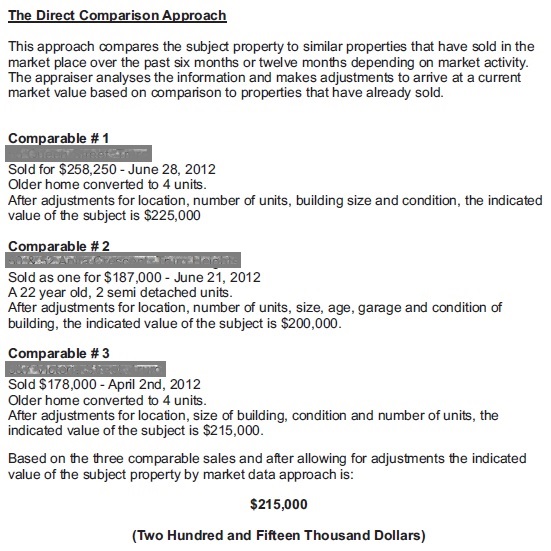
Direct Comparison Approach: This compares the subject property to similar properties that have sold in the market place over the past six to twelve months depending on the market activity.

Income Approach: This calculates today's value of the future income of the subject property by analysis of current and future cashflow and actual or anticipated income.

Realtor's use the direct comparison approach as they should, but for a Buy/Rent/Hold property I want to add to my portfolio I use the income approach. With some of the properties I've purchase, the income appraisal is higher then the direct comparison appraisal, that is a great deal for me. Sometimes (most of the time) the income appraisal is much lower then the direct comparison appraisal. This is when my offers offends the realtors and sellers.

Here is a copy of an appraisal I had done on a property in the past.

Cost Approach:


Direct Comparison Approach:


Income Approach:


We ended up with three very different amount. I expected to get an average of all three but that was not how it worked out. Here is the summary of my appraisal:


I found it odd that the appraiser averaged the value to $217,500 when the average was around $234,500. The reason is because he was looking at an other amount; the accepted offer. I had an accepted offer at that time to purchase this property at $197,000.

My sister was upset with a neighbour a while ago. She owns a town house and the neighbour put his up for sale. He was a motivated seller, eager to sell and accepted an offer that was below the property value. Going forward that sell as significantly affected the Direct Comparison Appraisal on her property and those of her other neighbours.

Thursday, August 08, 2013

Good To Know: Exit Clauses

I've been getting a kick out of the real estate reality shows on HGTV but their are definitely a few investing mistake they seem to be doing. On "Income Property" they go around viewing a few different rental potential and pick the one they like the best and renovate the income suite. If they were educated investors, they wouldn't pick they favourite and then place an offer, they would place an offer on all three and take into consideration the price they where able to negotiate.


Sometimes on "Property Brothers" they negotiate their purchase with a lot of emotion. They almost always go above asking price and I've seen them remove all condition to ensure they get the property they have their heart set on.

Having exit clauses makes it that in the first scenario you would be able to place an offer on all three properties even when you only intend to purchasing one. An exit clause is like the exit signs, it's your way out should you need it. It is your safety net should something happen that the property you are trying to purchase is no longer a deal. So in the second scenario, I don't agree with taking away the safety net.

You can put in as many exit clause as you would like, but at the end of the day you only need the one. Your exit clause should indicate that it needs to meet your approval and the realtor will make sure that there is a date associated with it. I like to stagger the dates of my exit clause, for example: inspection at a certain date, insurance a week later, and financing a week after that. Those are the three condition I normally use for my exit clause. You could also add partner's approval, or lawyer's approval, and so on.


I also add a few terms, the right to assign and depending on the type of investment (lease option for example), the right to show. Be sure not to waive your last clause until all your ducks are in a row and you are ready to move forward.

Thursday, August 01, 2013

Good To Know: Making Offers

In the real estate world the only way to succeed and get ahead is to make offers. It's actually the foundation to it all. It's the only way to move forward. You need to get a property under a purchase contract and to do that you need to send an offer.

Making offers can be intimidating. This year, I've inquired and sent offers on 193 different properties. I've been concentrating on multi unit rental properties


That number should actually be much greater, but I have the bad habit of slowing down when closing on properties and around big holidays like Christmas. Still, 193 is nothing to sneeze at. This is why my database is so important. I just can't keep track of so many properties. In my database I keep track of the MLS number if it's a listed property, the province, city, address, the asking price, the number of units and my notes on the deal.

Before you can start the database, you need to start contacting realtors and sending offers. Start sending email to realtors, ask for the income and expenses details on properties. Once you receive a reply with the information you requested run the numbers. To make this streamline I use a spreadsheet that calculates all the income as well as all the expenses. Be sure to take all expenses in consideration. Most of the time the income and expenses does not include expenses for vacancy, maintenance or management. Be sure to add an amount to your calculation for those. Also take in consideration debt repayment, and if you are taking on investors for the down payment, debt repayment would be for 100% of the price. Based on your calculation, figure out what your asking price would need to be to obtain the cap rate you desire.


The numbers should be your only guide to what your offer should be. This is the difference between investing in cashflow and investing in appreciation. We invest in cashflow! Investing in appreciation is gambling. So once you get the amount of what the property needs to be to obtain the desired cap rate that is the most you can offer for this property. Your first offer should be 80% of that number, or 90% if the seller is willing to hold a VTB (Vendor Take Back / hold a second position mortgage).


All of these calculations should be on your spreadsheet, making the process of running your numbers quick. You get a big advantage with you realtor if you can give them answer on the information they sent you within a day. Even more so when you can offer them an amount every time.


By now you may have realised that most of the time, our first offer will be embarrassingly low. Keep in mind, you lose nothing by sending in your low offer, but if you don't you will gain nothing. If the offer is really low, instead of sending an offer, send the realtor an email saying that you have run the numbers and and based on your criteria your first offer is in the ball park of "x" amount. Let them tell you know if the seller is interested in seeing this offer. But at least that way, your interest as been made known. If the seller is not interested yet, he may become motivated down the road and he will know where you sit.

So design your spreadsheet to make running the number a breeze and start sending in offers. Hundreds of them.


Next week, I will discuss which clause should be in your offers.

Thursday, July 25, 2013

Good To Know: GoToMeeting Q&A Session

If you have visited my Up Coming Events page you would have seen the poster for the new up coming series Q&A With Real Estate Investors. Each session will be held every second Tuesday at 7pm MST. Space is limited to twenty listeners so be sure to contact me to register to each event. If you where unable to attend or that the session was filled before you could register you can also contact me for the recorded version.


My first guest speaker will be Shin Kawaguchi from Alberta. Shin was a Rich Dad Education student and as taken his new knowledge to secure many different real estate investments. He will be discussing the mind set involve in real estate investing as well as his background and real estate experiences. I'm excited to attend this Q&A session as there is a lot I can learn from his knowledge and experiences.


I hope you can join me in this first Q&A With Real Estate Investors and ask your questions to Shin.

Thursday, July 18, 2013

Good To Know: Why Everyone Should Have An Home Equity Line Of Credit

Today I attended an online webinar organized by Rich Dad Education. Their speaker was Jeremy Reese.

When he was younger, his parents where not wealthy people but lived comfortably owning their own home. His mother was a photographer and his father would develop them, running a business together. When he was 18 years old, Jeremy was in a motorcycle accident. Which was the cause of him loosing his leg. He was in ICU for 4 months. As where is parents, making difficult life or death decisions fighting for the survival of their son. During that time neither of his parents could work and the business went under. They also ended up loosing their home as they were unable to maintain the mortgage payments.

Now imagine the same situation if they had taken advantage of the equity they where slowly building on their home by having made the regular mortgage payments for years before the accident by having obtain an Home Equity Line Of Credit. Jeremy would still have had his accident and his life would still be in jeopardy. His parents would still have had to stop working and their business would still have gone under. But while they where unable to work, they could have resorted to the line of credit to maintain the payments on their mortgage. Giving them the ability to stay focus on the survival and recovery of their son. Lessening slightly their level of stress in such a horrible situation.


In these days, many peoples retirement plans is suing someone else. It as become a terrible truth to our justice system. Imagine someone is walking their dogs in the middle of a snowy, icy, Canadian winter day; and they slip and fall on the sidewalk in front of your property and they brake their arm. They decide to take advantage of their misfortune by suing you, the home owner. Off they go to their lawyers office and explain the situation. The lawyer seeing dollar signs all over their story approve of their case and decides to look into it closer. So Mr. Lawyer does a quick background check on you, and realize that although yes you do own your own home, there is a large amount against it leaving almost no equity. The dollar signs quickly vanishes and although he would still be willing to take on the case, it will now be at the plaintiff's expenses. Lawyer's are not cheap and the plaintiff may rethink his decision to sue. Even if the Home Equity Line Of Credit as not being used, when the lawyer does his background check it will still show up against the property. If that was not in place, the chances of the law suit taking place would be a lot more likely.


Our society is very scarred of debt. We have been brainwashed to constantly work of getting out of debt. When in fact it should be get out of bad debt and accumulate good debt. While unused, payments of a Home Equity Line Of Credit is $0. You only have to make the payments when it is in use for the amount that is used, and at that point it is interest only. So in Jeremy's case, his parents wouldn't have had to worry about paying off the Line Of Credit until they were back at work when Jeremy was home again.

As an investor, you can simply imagine how having access to this cheap easy money would benefit for closing on deals giving you a little more time later to either refinance or to set up arms length mortgages.

I hope you see the safety possibilities that an Home Equity Line Of Credit can offer. If you do not currently have one in place, I strongly recommend that you consider applying for one soon. Because if the occasion arise that you could need one, you will no longer qualify to obtain one.